Stickman's Guide
to
Bangkok

DirectRooms - discount hotel reservations
A great choice of discount hotels in China:
• Beijing Hotels
• Guangzhou Hotels
• Guilin Hotels
• Hong Kong Hotels
• Kowloon Hotels
• Macau Hotels
• Shanghai Hotels
• Shenzhen Hotels
• Xian Hotels

Living and Working in Bangkok


Introduction

As the plane banked, I peered from my window seat down on city where everything was a shade of grey.  Bangkok.  Residential areas adjoined by industrial estates and a mass of drab, grey run-down apartment buildings made me reminisce of a previous visit to Eastern Europe.  I could see streams and streams of traffic but they didn’t seem to be moving.  Thank God I have a connecting flight to Hong Kong and will be in and out of the airport in no time.  Thailand hardly looked like a tropical country.  My first venture into the country and everything looked so dirty.  I then thought of the commercial sex industry often portrayed in the Western media and the millions infected with AIDS.  Of course the country was famous for its food but isn't it a bit too hot to really enjoy?  Get me away from here, fast!

These were my thoughts just a few years ago when I was flying from London to Hong Kong, with a transit stop to change planes in Bangkok.  I would NEVER have dreamed that just three years later I would be going to Thailand for a holiday and that four years on I would be living there.  If this trend continues, I could be living in Russia in a few years time – because I sure as hell don’t want to go there now!

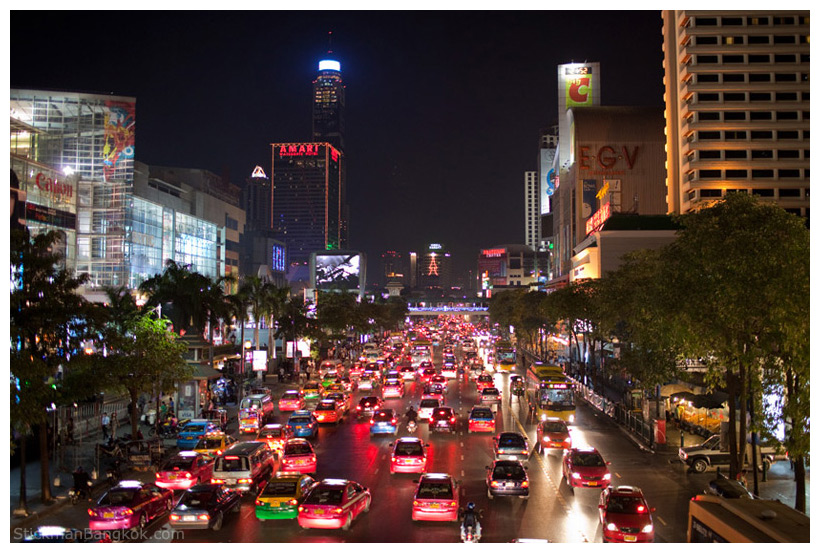
Bangkok, The City Of Angels.  The name conjures up images of the Orient, intense traffic jams, unrelenting tropical heat, extreme pollution, spicy food and an energy and vibrancy that can only be found in the most exciting of all continents, Asia.  Bangkok can be confusing and frustrating when you first arrive and this section of the website aims to prepare you for the mayhem that is this city - hopefully without making the same mistakes that many people before you have made, me included!  This site should also appeal to anyone coming to Bangkok for a holiday and may help to give you a few pointers on how to make the most of your time in the Thai capital.
Everything here is presented in a no-nonsense manner.  There are many sites on the web with information about Bangkok / Thailand but too many of them just repeat information that is readily available elsewhere.  The objective of this page is to provide practical information in an organised manner and to answer the questions that many people ask.  Basically, what I have tried to do is provide answers to all of the questions I had before I moved to Bangkok.

Remember that while this site is intended to provide practical information, it does include quite a few opinions so you need to understand that this is how I see Bangkok.  You could very well see things quite differently!  If you have any specific questions about Bangkok or Thailand in general, feel free to email me and I will be happy to answer them.  If I think the information would be useful to others, I will add it to the site.

Everything on here is my own work and is largely based on my personal experiences.  What is written here is all original.  I do hope you enjoy this section of the site and I hope that the information here helps you to ease into life in the hustle, bustle and excitement of life in Bangkok.  The bulk of this information was written in 1999 and 2000 and looking back over a lot of what I wrote, I was a bit of a minimalist back then, perhaps a bit too frugal.  Hence you might find the tone to be that of someone a bit too tight with their money!  Still, I go back over it and update things frequently, trying to make sure things are up to date.

A lot of other information about travelling in Thailand is listed in the Travel in Thailand section of this website.  Although that section was written as a guide to travel around the country, it also includes a lot of information about life in Bangkok too so it may be worth skimming over too.

Please note that this page is just a fraction under 100,000 words, hence it is actually the size of a full-length book.  It is not designed to be read in one sitting.  You're best to read one section at a time, go away and come back and read more later.  If you were to read it all in one go you'd be looking at several hours' reading!
 

About The AuthorProblems, Corruption & The Police
OrientationThai Language
Thai PeopleEntertainment
WeatherInternet / Mobile Phone
Employment, Visas etc.Miscellaneous
AccommodationCost Of Living / Shopping
FoodSurviving In Bangkok
Transport / Getting AroundMust See Attractions

About the author

I have been living and working in Bangkok since the late '90s.  I first visited Thailand with a friend on a short holiday in 1997.  Unlike many who come to Thailand, I did not fall in love with the country.  In fact even before the end of the holiday I was ready to go home.  Despite the fact that we were staying in a great hotel next to a really fabulous beach, the overwhelming heat got to me, and that, along with a bout of very nasty food poisoning were enough for me to want to return home.  I returned to my homeland and while reflecting on the holiday, realised that I'd had a good time and would like to go back again some time.

I had always wanted to live and work in a foreign country and the opportunity to learn a foreign language and get really good at it, and experience another culture, quite different to that of my own country.

It wasn't a hard decision to make but I did I give up a very comfortable, but relatively boring and largely predictable lifestyle, to pursue a new and potentially exciting lifestyle in Phuket.  Yes, you read that right, Phuket, not Bangkok.  But somehow that never quite happened.  I spent 3 and a half weeks on Phuket followed by 2 and a half on Ko Samui before arriving in Bangkok which I quickly realised would be a better place to search for work.

In the time that I have been living in Thailand, I have spent most of the time employed as a teacher, initially as an English teacher and then later as a teacher in a high school.  In between these two jobs, I took the best part of a year off to study the Thai language formally in a language school, an experience I thoroughly enjoyed and one I would actually like to do again in another country.

I have travelled around much of Thailand, including all of the major centres as well as many smaller places and out of the way spots.  I guess I have visited about half of the country's 76 provinces.  While I have enjoyed every place that I have visited, I always feel like I have arrived back home when I return to Bangkok.

I am male and I first came to Bangkok single but after five years in the Kingdom I married a local lady, something I had previously vowed never to do.  Ahhh, we have all said some silly things in the past, haven't we?!  In fact my life changed a lot in my first five years which I guess was around the point that I decided that yes, my future probably really was here, in Thailand.  At the five year mark, I finally moved out of the hovel where I had spent my first five years, into a reasonable sort of a place and started leading a life quite different to the tourist like existence I had previously led.

Although most people consider me a bit of a nice guy, I do tend to be argumentative and have a few strong opinions on a few controversial issues.  Some of these strong opinions are represented here although I have tried to emphasize the factual information rather than harp on about my own opinion too much.  So, you have a bit of a mix of facts and opinions and I try to qualify things so you know which it is!  I do not purport to be any sort of expert on life in Thailand or anything silly like that...I just simply enjoy writing about it and I hope you enjoy reading my nonsense ramblings.

Orientation

Bangkok, a city of over ten million people has experienced phenomenal growth in the last thirty years.  In the early '70s, the city had around 2.5 million but now has well in excess of 10 million inhabitants as many Thais from the rural areas have moved to the big smoke in search of employment, and a better lifestyle.  This rapid growth meant that Bangkok grew too fast for its infrastructure and the centre of the city could accurately be described as organised chaos and with this in mind, Bangkok is a little unusual in that it doesn't actually have a city centre as such.

Some people consider the heart of the city to be the Silom and Sathorn Road area which is the financial district and the commercial centre where many of the banks, financial institutions, international corporations and embassies have their offices.  This is also the area where you will find many office buildings, airlines and some of the best hotels.  Others consider Siam Square to be the centre of Bangkok where one can find three major shopping centres at the intersection of Rama 1 Rd and Phyathai Road.  It's the main hangout for Thai teenagers and the trendy set and is thus a very good area for shopping.  The prestigious Chulalongkorn University, acknowledged as the best university in the country, is nearby.  But there are others still who say the heart of Bangkok is Rajadamri Road where it meets Ploenchit Rd.  In this area you have shopping centres such as the Central World Plaza (previously known as the Bangkok Central World Plaza) and Gaysorn Plaza plus Pratunam Market, a few embassies and a few of the more luxurious hotels plus the all important Erawan shrine.  All three areas are hubs for buses going just about anywhere in the city and Bangkok's sky train services all three areas too.

Wat Arun, one of the many visually striking temples in Bangkok.

One of the easiest ways to orientate yourself in the city is via Sukhumvit Road which runs into Ploenchit Road and that in turn runs into Rama 1 Road.  This main arterial route runs east-west through the city from east of the Chaopraya River all the way to the east of the city and beyond.  It is intersected by many major roads running north-south such as Phyathai Road, Asoke, Rajadamri Road and Rachadapisek Road.  Sukhumvit Road and all of the lanes (sois in Thai) running off it are popular places for farangs to find long term accommodation in Bangkok.

Although there is a trend in the West towards moving shopping and entertainment into the suburbs, no western city that I know of can match Bangkok for the distribution and decentralisation of shopping centres and entertainment facilities.  No matter where you are in the city, you are never too far away from a shopping centre, cinema, market or any of the many types of entertainment that are popular in Bangkok.

Bangkok could never be described as a particularly pretty city.  Despite their being a beautiful Buddhist temple in every neighbourhood, no matter where you are, you cannot escape the drab Chinese shop houses, uneven and poorly laid footpaths and roads, derelict down and out beggars and clusters of electricity and telephone wire hanging haphazardly around.  To make matters worse, litter clutters many roads and sois (a word you will hear often which simply means lane), rats run around and this all contributes to the city having a very distinctive smell.  The sprinkling of temples, canals and even the gently swaying palm trees do their best to dress up the city but ultimately, they fail.  Having said all of that, I haven't met a person yet who has come to Bangkok for the aesthetics of the city.  Where Bangkok thrives is in the vibrancy and energy that you feel, no matter where you venture.  Once upon a time, Bangkok was described as the Venice of the East because of all of the waterways and canals throughout the city and the many wide, leafy boulevards.  However, as the city is storming its way towards being a truly 21st century city, the development has happened so fast that many of the city's better features have been ruined as largely unplanned and poorly co-ordinated expansion have seen the city sprawl out in every direction possible, encroaching upon the bordering provinces in much the same way as London grew out over surrounding villages, 100+ years ago.
 

Thai People

There are many reasons why people decide to move to Thailand - the tropical weather, the exotic culture, the paradise-like islands and beaches, the delicious food and the fact that one can have a decent lifestyle for a modest amount of money.  But in addition to all of these reasons so often given, the Thai people themselves are an attraction.  The majority of Thai people are friendly and often when you smile at a Thai you will receive a pleasant smile back.  Certainly of all of the places that I have been lucky to visit, I have never met a nation of people as friendly as the Thais.  Welcome to Thailand, the Land Of Smiles!

There is a real community spirit amongst the Thais, and a feeling of national pride.  The Thais seem to get along with each other a whole lot better than us lot from Western countries.  Where in the West there always seems to be some sort of conflict, in Thailand the locals seem to get along a whole lot better.  A good example can be seen in schools.  In the West, bullying is a problem with the bigger, tougher kids often picking on the younger, weaker ones.  This sort of nonsense does not occur in Thailand (though they do have some really fierce inter-school battles with knives and guns as is reported in the press from time to time).  You also see it in everyday folks' lives.  Many Thais go out of their way to help their neighbours, far more so than I have seen in the West.  When cooking food, one person may cook extra and walk around the community, be it an apartment building, a village or wherever, and deliver bowls / plates of food to their neighbours.  This all contributes towards creating a warm spirit amongst the Thai people.

The Thai smile itself needs some description.  Thais will frequently smile at all manner of situations, but the Thai smile should not be interpreted the same way you interpret smiling in the West.  In the West if someone smiles it usually means they are happy or pleased about something.  That may be the meaning in Thailand, but it is just as likely something different.  Thais may smile as a form of apology.  They might smile if they are asked a question to which they do not know the answer.  They might smile in an attempt to diffuse a situation.  Most importantly, a smile in Thailand does not necessarily mean the same as a smile on the West.  Thais do however look favourably upon people who smile frequently and often.  So smile as much as you can!  Thailand is a rather litigious society, with many disputes not necessarily solved in court, but rather in a police station and I have sometimes wondered if one of the reasons Thai people smile so much is so as to not piss off others!

The Thai people are incredibly patriotic and love their country.  Ask the average Thai where they would like to go for a holiday and they will usually say somewhere in Thailand - even if you state that money is not an issue.  Hypothetically, give a Thai the option to emigrate to another country and they would usually turn it down.  As one of my Thai teachers once said to me, "I feel very lucky to have been born in Thailand" and she then looked at me as if being born in the West was based on some sort of bad karma, a sin that I had committed in a previous life!  The Thais really are happy in their own country and this contributes to making Thailand a really nice place to live.  How many other countries have you ever been to where the people genuinely love their country and are simply disinterested in going elsewhere?

Thais are very proud people and their love of their country is very strong and although you may hear Thais complaining about the Bangkok traffic and pollution, the economy, politicians, corruption and various other facets of life, you should be very careful about making such criticisms of Thailand yourself.  To do so could be taken as a huge insult to the Thai and would not endear you with that person at all.  As nice as they are, Thais are not very good at dealing with criticism, even if it is light-hearted, or even meant as a joke or an ice breaker.  This is something that one needs to be aware of.  Thailand is still a developing country, and there are a few things that happen that Westerners often wonder about.  While these issues may occur, often it is best NOT to talk about them, or at least not highlight them in conversation with Thai people.  They know that such things exist but would prefer not to be reminded of them.  Intelligent conversation and discussion about some of the problems and issues that exist in Thailand is not always easy to find, especially amongst those people with a modest education - which really is a good percentage of the population.

Thai culture is extremely complex and even the most conscientious and diligent foreigners who have lived in-country for a long time and have made an effort to understand as much as they can will inadvertently make cultural mistakes, yet Thai people are generally very tolerant of foreigners.  Foreigners continually make cultural mistakes in Thailand, yet the Thais will more often than not waive these cultural errors, choosing to overlook them and continue to smile and be happy.  This happy go lucky attitude and the level of tolerance in Thailand makes it a very easy and pleasant place to live.  To a certain extent, Thailand has isolated itself culturally, distinguishing the country from so many others, though the Thais understand that they need to be tolerant of those who do not understand Mother Thailand's ways.

I often feel that I discover something new every day about Thai culture but while I am learning more, it can at time feel like it all just seems to become more and more confusing!  But have no fear for so long as you are polite and make an effort - as you should in any new country that you visit, you needn't be aware of all of the complexities and peculiarities of this unique and rich culture.  A colleague once described the situation as being similar to peeling an onion.  You peel away at the onion and feel that you are getting closer and closer to the centre.  But really, you are not making a lot of progress and there are literally 100's of layers to go until you reach the centre.  You may live and work in Thailand for a long time but unless you move to Thailand from a very young age, you will never reach the centre of the onion.

There is a very distinct class system within Thailand.  Business and the distribution of income in Thai society is largely dominated by the wealthy - the predominantly Bangkok based Thais, many of whom are ethnically Chinese.  The Chinese Thais, as they are often referred to, can be recognised by their fairer skin and more Chinese look.  At the other end of the spectrum are the villagers and farmers from the countryside, the rural Thais, who are easily recognisable by their darker skin and generally smaller, often stockier stature.

The class system in Thailand is a little different to that in certain other countries where the lower class Thais do not resent those in the upper class.  In fact, the lower class may look up to the upper class and aspire to be in a similar situation.  While the wealth in Thailand is predominantly in Bangkok, there is also a lot of money in the south of Thailand where a number of industries thrive.

While they live together harmoniously enough, many people from these two particular groups have very definite opinions about each other.  Some "native" Thais consider Chinese Thai to be greedy because of the Chinese Thais' apparent love affair with money and their reluctance to part with it.  As employers and when in business, some Chinese Thais have the reputation of being real penny pinchers, negotiating every price down to the last satang (1/100 th of baht!).  Further, the Chinese Thais do not tend to be as friendly as the native Thais.  The Chinese Thais do work hard and tend to be more driven and business oriented, like so many Chinese people throughout SE Asia and around the world.  I have heard some Chinese Thais describe the Thai Thais as lazy.  One could argue that the Thai Thais do not have the best work ethic in the world and some things tend to be done at their own pace and in their own time.  Indeed, wherever you are in Bangkok, you will likely see peoples laying around, maybe even sleeping in the middle of the day.  And I often join them because of the heat!  I maintain that Thais as a race are amongst the most friendly people you could ever hope to meet.  (The people in neighbouring Laos and Cambodia are very friendly too.)  Notwithstanding these racial differences, there are not the same social problems in Thailand that exist in Malaysia, and especially Indonesia where there is real tension between the "Chinese locals" and the "native locals" - and indeed legislation in place that gives advantage to some groups.

Males and females are brought up in a very different manner in Thailand.  Girls are taught to be prim and proper and to do everything in a most polite and feminine reab roy way.  At times it seems the girls in Thailand today are brought up much the same way as they were 100 years ago, but as Thailand becomes more and more influenced by the West, girls are starting to become a little more rebellious, and not necessarily conform to the traditional model.  Young boys on the contrary are given freedom and encouragement to roam and have fun.  You can see symptoms of this within Thai society on a day to day basis.  Only a small percentage of Thai females smoke and those that do tend to be from either the very high or the very low echelons of society, where smoking will not damage their social status, which is already secure.  As a percentage of the population, many mire Thai males smoke than females, but not nearly as many as in the West.  Watch Thai children in public - public transport is a good spot to observe.  The Thai girl will set there quietly, minding her own business while the boys, in many cases, will be yahooing around having a riotous time!  As their lives develop, some Thai men may become quite promiscuous whereas a married Thai woman would seldom stray away from her husband.  While these stereotypes do still predominantly remain, things ARE changing - and in 20 years time, some people question whether Thai society will not be all that different from the West, notwithstanding that the current Government is doing all that it can to keep Thailand in the 20th century and retain the traditional Thai values and morals.

I'm not so sure I like the way the wealthy in Thailand seem to do things to protect their position in society by removing opportunities for the poorer folks and continually pushing them down.  A bright kid from a poor background may miss out on the chance to study at a good school because of bribes paid to that school by the rich parents of a less intelligent kid to allow their kid to get a place that he / she really shouldn't have had.  Yep, I have seen this first hand and have even had certain wealthy people tell me exactly how much it cost to get little Somchai into a good school.  It is so often a case of the wealthy buying their way in society and trampling the opportunities of the poor.  And then there is entry to certain prestigious institutes and establishments.  This old boys club continues right through one's life time and the poor are almost slaves to the rich in many cases.  This really winds me up so I had better leave this here.

This class system takes many, many forms.  The very clothes that people wear are an indicator of what sector of society people where - not just fashion names here, but the styles that they choose to wear.  The places where people go, the way they choose to travel, the places that they eat and God damn it, even the food they choose to order!  Whatever you do in Thailand, it so often seems that you are being looked at, examined, and your place in the hierarchy is determined.  Another example is sport.  Bangkok Thais tend to like soccer which would be their favourite sport whereas in other parts of the country, Muay Thai is more popular, at least in terms of participation.  Some Bangkokians may consider Muay Thai to be a "peasant's sport".  People from poorer provinces with dark skin continue to struggle to be accepted in Bangkok and often find it difficult to get work other than unskilled labour.

Upon meeting someone new, Thais will often ask a few questions based on age, job, education, family and other general information to gauge the other person's status.  They will then address them accordingly with pronouns and honorifics that reflect their relative status.  Someone of superior status would be addressed as pee followed by their nickname while someone of a lesser status would be addressed as nong and then their nickname.  As a foreigner, I don't like to use these terms as I feel they re-enforce aspects of the Thai class system, something that I am not fond of.

Thai people have both a "full name", that is a first name and surname, which tends to be used on all official documents, in employment and generally used at more official occasions.  In addition to their real name - or cher jing, all Thais will have a nickname, or cher len.  Thai names can be long and may be difficult for a non-Thai to pronounce correctly while the nicknames are conveniently short, usually one syllable.  Examples include Nok, Daeng, Noi or Fon.  When meeting a Thai person for the first time, they will usually offer you their full name but if you get to know them better and become more familiar with them in a social context you will be probably refer to them using their nickname.  Some nicknames are just an abbreviated form of the full name such as the name Suripon which may be shortened to Pon, as a nickname.  Many Thai nicknames have a literal meaning and a few of the more common nicknames are listed here.

Gai - chicken
Daeng - red
Fon - rain
Jeab - baby chicken

Sanuk, the Thai word which means fun or enjoyment is paramount in the Thai way of life.  The Thais believe that for something to be worthwhile, it really should be sanuk.  If it's not sanuk, it may quickly become boring to the Thais.  Thais can frequently be seen laughing and enjoying themselves in whatever they are doing.  If the enjoyment wanes, the activity may well cease.  This carries on all the way into employment and a Thai may resign from their work if it is not sanuk although as often happens, economic necessity may compel them to do something that they do not necessarily enjoy.

The whole idea of living a lifestyle where everything is fun is great in principle, but it doesn't always work.  One example is that there are certain things in life that are quite frankly a hard slog and there are times when you imply have to do the hard yards.  In certain situations, the locals can get fed up easily and not want to do the hard yards.  A classic example is in the study of English where certain parts of it, particularly the grammar parts, can be difficult and require extra work.  Thais can get very bored when it comes to things like this and complain that it is not sanuk.  The other situation when things get take the other way is when they try and make something sanuk and it gets out of hand.  Take the case of an auction.  We got to an auction to bid on an item but the idea is to try and get it for a god price.  Take a simple household item like a glass.  Such would sell in a department store for perhaps 10 baht.  But if you were to auction it off to a bunch of Thais, the whole idea of bidding against each other is deemed to be fun and they will keep bidding well beyond the 10 baht price and son of them, the "winner", might end up paying as much as 100 baht for it, ten times more than they should.  Yep, sometimes the idea of sanuk gets taken just too far!

All Thai people, from every strata of society, and every religion, are very, very fond of His Majesty The King.  The world's longest reigning monarch has dedicated his life to his country and his people.  Not only are there many, many royal projects that his majesty has overseen, he is a visionary whose philosophy drives the Thai people.  His majesty has impressed upon his subjects the importance of self-sufficiency and this has now become a part of Thai people's philosophy.  One should never make any negative comments whatsoever about HM The King or the royal family.  To do so is the ultimate insult to Thai people, Thailand and the country's most respected figure.  Any negative comment may result in an extremely harsh reaction from Thai people.  It is also a very serious breach of the law.  The seriousness of this cannot be overstated.  Simply do not joke or even make the slightest criticism of HM The King or anyone in the Royal Family.

The vast majority of Thai people are Buddhist and while people are free to follow any faith, you should also be careful about discussing anything religious related, especially about Buddhism.  While in the West intelligent discussion is encouraged, irrespective of the topic, here in Thailand, religion and the monarchy are best not talked about at all if you have any negative opinions whatsoever.

Buddhism is the dominant religion with the vast majority of the population claiming to be Buddhist, well over 90% of Thais.  There are a few provinces in the deep south, just north of the Malaysian border, that have a greater number of Muslims than Buddhists to the point that even though they are geographically Thailand, you could be mistaken for thinking you were in Malaysia.  Funnily enough, in these particular provinces, the culture really does not feel so Thai and I have never felt entirely comfortable down that way.  And it should be noted that over the past few years there have been safety issues.  The deep south of Thailand is the one part of the country where it is wise to seek out travellers information from your embassy before venturing there.

Thai people are generally friendly, charming and hospitable but unfortunately many lack the opportunities, or money, to get a good education.  With agriculture still the largest industry in terms of employment numbers, many Thais work in a position that in the West would be classified as unskilled labour.  With limited opportunities for employment in the countryside there is no real requirement for a higher education there.  Having said that, those who reach a higher education are certainly admired in Thailand.

With 50 odd students in classrooms in government schools, students don't get the same amount of individual attention and to further exacerbate the problem, the Thai education system quite simply does not emphasis the need for students to think for themselves.  Student-centred learning has been mentioned a lot in the press, though whether the curriculum changes to introduce this more modern teaching style, who knows?  Having had the pleasure and privilege of teaching English in some Thai schools, I have had the opportunity to observe the way the Thai teachers teach.  Their teaching methods are a little dated and many simply stand at the front of the class and preach at the poor students who are expected to sit there and listen and lap it all up but they quickly bore of it - it's not exactly sanuk is it?!  This contributes to an education system with room for improvement.  That said, with 50 students in a classroom, teachers cannot give the students too much flexibility for fear that they will run riot - they simply have to keep the lessons tight and standing up in front of them and talking at them, followed by giving them some exercises.  Rote learning is alive and well in Thailand and Thai students are very good at remembering things.  Critical thinking is sadly not high on the list of Ministry of Education.

Outside of Bangkok, many students only go to school for 6 years, which used to be the minimum requirement, meaning that they received a very limited education.  (For some of the really unlucky kids, they may have got even less.)  Fortunately, the powers that be are seriously looking at overhauling the education system, and with a bit of luck replacing the current one with a system that will hopefully produce more well-rounded students.  Part of the reason that some kids get such a limited education is that the parents simply don't have any money to pay the school fees, buy school books and uniform.  Of course this is extremely sad.  Another reason is that the parents simply pull the kids out of school so that they can help around the family business which is often a farm.

Looking east from the Asoke BTS station.

In Thailand there is often a rule or a way that things get done - and almost everyone (but not foreigners) knows it!  The fact that most people do something a certain way is probably because they quite simply aren't encouraged to try and think outside of the square and do it differently.  You have to be careful because if you question others, someone may lose face - and you really do not want to be responsible for that!  This can be rather frustrating at times.  There is not a lot in the way of challenging the way that things are done and trying to do them "better".  This means that when mistakes are made, or when a system is being used that is not entirely efficient, it will in all likelihood continue to be conducted in that manner and improvement or change will be very, very difficult.  Foreigners unwittingly stray from the rules every day.  A classic example of this is in McDonalds where I will ask for an iced coffee without ice and you will get some mighty strange looks from the attendant.  Iced coffee without ice?  Is he crazy?  Fortunately, Thais who have been educated overseas or have had exposure to foreigners seem to realise that some people do things a little differently.  Actually, I have noticed things changing a lot and I guess it is because there are more and more foreigners in Thailand these days, that is more and more people doing things differently.

Sometimes we have to remember Stickman's little rule:  For foreigners two plus two often feels like it equals three!  Don't try and think about it too much because that's the way it is.  As foreigners living and working in the Kingdom, we do have to remember that Thailand is not our country and that we are here as guests, often uninvited guests!  While some aspects of life in Thailand can be frustrating, try to look in the bright side and at all of the positives, of which there are so many!  My advice is to just get on with things and try not to let the little things bother you too much.  That really is one of the tricks to enjoying a happy life in Thailand.  If you are the type who sweats the small stuff, you might struggle.

Loosely related to this is the predominantly Asian notion of "face".  Face plays a big part in life in Asia and cannot be underestimated.  Every effort should be made to understand the issue, and how to operate in such a way as to not cause others to lose face.  Face is sort of like one's reputation or image and concerns one's demeanour, their way of doing things and indeed their very success in life.  It concerns so many things from the clothes that one wears, to the way that one goes about their daily routine right through to job and possessions.  Someone with a lot of gold jewellery gains face because the gold shows that they have been successful in one way or another - maybe they had a job that gave them enough income to buy the gold in the first place or perhaps they have a wealthy boyfriend who lavishes them with gold jewellery.  Why do you think many folks in Thailand openly wear their mobile phone (or phones!) on their belt or outside the body where they can be seen?  Everyone can see that they have this expensive device and they gain face!  Contrast this with a poor farmer whose clothes are old and less fashionable.  This fellow will potentially lose face, or at least not be looked at favourably, due to his presentation and his perceived position in society.

Back in my homeland, I like the fact that I can go out and wear pretty much anything.  People will not pass judgment on me.  This is one thing I prefer about my own country over Thailand, though even back there, one does not want to look too much like a homeboy for fear of being negatively stereotyped!

When a Thai makes a mistake or does something wrong and this is pointed out to them or perhaps worse still, others are made aware of it, the Thai who made the mistake loses face.  This can in fact be quite hurtful to a Thai and if a Thai loses face badly enough, there is no knowing how they may respond, and quite frankly, there is no limit to what they might do.

I am of the opinion that this can become a problem in the workplace.  Someone makes a mistake but the error is not pointed out.  So, as the error has not been brought to their attention, they continue to behave / do things in that manner and the mistake continues to be made again and again.  This inhibits one's ability to improve, develop and make progress.  In that way, face can be detrimental.

You can however use the concept of face to your own advantage.  Praising someone in front of their friends / colleagues / peers will make them gain face and you will find that they may suddenly become more helpful and / or more receptive towards you.  If someone is being unhelpful or not providing the level of service that you require or expect, rather than complain as you may in the West, consider complimenting them on something that is positive about themselves and you may find that the level of service increases!  I don't like pushing Western values and the way of thinking upon those within Thailand, but one cannot help but wonder if face can hold things back.  Certainly, as Western investors continue to invest in Thailand, many of these investors will struggle to accept this.  The issue of face is a big one and you need be aware of it.

Another way to look at face, or the way that many Thais may look at it, is that they want people to view them in a positive manner, and they want to be seen as good people.  To a small number of Thai people, they may be more interested in being seen to be a good person than actually being a good person.  Contrast this with most people who are more likely to genuinely want to be a good person and less concerned (though still concerned somewhat) with what others think of them.

In Thailand, remember that things may happen in Thai time.  Arrange to meet someone at a certain time and they may well arrive quite late - sometimes as much as an hour or more - don't be too surprised because Thais operate on this concept of Thai time which basically means, they'll turn up when they are ready.  I have got to say that for me, frankly, I don't like it nor I do I accept it.  I always tell Thai friends that I may be meeting that for me, this is totally unacceptable for them to be so late.  Some people may find it shocking that someone would mention this, but it does mean that they are almost always on time.  Generally speaking, folks from the higher end of society are far more punctual than those from the lower socio economic sector.  Hardly PC to say this but hey, in my experience that is how it is!

The Thais are a friendly bunch and will charm all but the most cynical and negative foreigners.  But everyone has their limits and you don't want to upset a Thai.  If pushed too far, some Thais may not just lose their temper, but go absolutely berserk.  My theory as to why this happens is due to the concept of remaining calm at all times despite what is happening around you.  Don't get me wrong, I'm a big fan of this in principle and it has got to be a good thing.  Dare I say it though, I think we all need some sort of outlet for our frustration and anger at times and this concept denies this much needed outlet.  It seems that some folks have all of this pent up anger and if they flip, good God, they have the potential to go crazy!

Be very, very wary if you get into an altercation with a Thai.  Unless you have some military training, are a martial artist or are armed, they will likely kick your butt good and proper.  And be aware that if there is an altercation involving a foreigner and a Thai, the average Thai passing by will often side with his compatriot, notwithstanding that they not even know what the dispute / argument / fight is about.  A colleague of mine once said "If you get into a fight with a Thai, you are fighting all 65 million of them".  However, don't read too much into this paragraph as you are very unlikely to ever have any such problems unless you are the type of person who attracts trouble.

The average Thai deplores violence as much as the average Westerner.  I've heard it said that Westerners should avoid Thais from the lower classes who have had a few drinks but my experience is quite the opposite and that these people are very hospitable and quite a laugh.  Hey, if nothing else it is a great way to practice your Thai language skills!  Please do consider that most altercations Westerners are involved in occur late at night, usually after midnight, and involve alcohol.  They often originate in the naughty nightlife areas so if you avoid these areas you should be just fine.

A lot of foreigners living in Thailand seem to have a love / hate relationship with Thailand and the Thai people.  There are all sorts of reasons for this.  Many Westerners get frustrated at the amount they put in to Thailand, both in terms of investment and in terms of effort, but are then given very little in the way of rights.  There is a very real feeling that Western residents of Thailand, even long-termers, those people who have been here for many, many years, that we are no more than long-term tourists.  We cannot buy land.  We must always go and pout our hand out for a new visa every year.  We have to pay more to enter national parks and to buy various products and services and we are so often made to feel that we are nothing more than walking ATM machines.  It is true that Westerners relocating to Thailand will never be afforded the same rights as Thai citizens.  It is no use complaining about it as that is the way it is.  I simply recommend that you deal with it.  That works for me.

Not that different from this feeling that some people get that we are welcomed for out money, and only our money, is that it is very unlikely that anyone will hit you over the head with a piece of wood, or stick a knife into your ribs and demand your money and valuables.  That said, local con men have no qualms about tricking it out of you, or telling you downright lies to get their hands on your hard-earned.  The belief seems to be that if you were silly enough to give it up then you deserved it - even if you were cheated!

A few examples:

- A friend had the misfortune to be in police custody.  A policeman asked where the fellow came from and my friend replied New Zealand.  The policeman then started going on about how he would love to go to NZ and could my friend help him with 20,000 baht for the ticket.  This simple request was turned down and was not accompanied by any bribe - like hell the policeman wanted to go to NZ!

- Another friend went out with a work colleague to a restaurant.  The bill was modest - less than 300 baht.  The Thai colleague who was older, more senior in the company and probably better-paid insisted he had no money even though my friend had seen a few thousand baht in the fellow's wallet earlier that evening!  This even goes against the Thai system of the oldest / most senior person picking up the tab.  The fact that no other Thai saw the manager essentially shirking responsibility for the bill meant that he didn't lose face.  Curious.

- I have heard of some people who have asked their farang friends for a loan for this or that but never paid the money back - in fact they probably never had any intention of paying it back in the first place.  I hate to say it but loaning money in Thailand - to a Thai OR a Westerner - should be seen as giving a gift, so only give it if you can afford to, and are prepared to lose it.

This is where another important concept needs to be mentioned.  A lot of Westerners do give the Thais grief about this and that, but I have found the average Westerner in Thailand to be no better, nor no worse.  Thailand doesn't always attract the best of the West - and that is being polite.

I have always thought that the Thais are a wonderful race of people, so friendly and gracious as hosts, but that money has this nasty habit of marring some.  This is easily overcome by not flashing a lot of money around, not disclosing your financial situation and simply not getting into discussions on the subject of money or income.  Downplay any conversation that swings your way and concerns money, income or assets, especially money earned in Thailand.  I admit that it can't be easy for locals who work hard all of their life for a relatively low salary and see foreigners coming to their country earning what really can seem to them to be obscene amounts of money.  The highest paid foreigners earning as much in a month as a Thai doing menial work might earn over their entire life!  Unfortunately, money can, at times, buy respect, and that is a hard pill for many Westerners to swallow.  Yep, it is those with the most money and the most toys, the most gold and the most Mercedes Benzes who get the most respect.

There are several phrases that you may hear the Thais use that concern fundamental concepts that are practiced in daily life in Thailand.  A lot of these phrases use the word "jai" - which means heart.  Following is a small guide to some phrases that you are bound to hear in Thailand.

Jai yen - literally translated as cool heart.  The idea is that you do not lose your temper and that you remain coo, calm and collected at all times.  If you ever show  impatience or show strong emotions, you will not impress the locals.  The Thais often use this phrase when someone gets hot and bothered.  It should also be noted that loosely related to this concept is that men should never lose their temper with a woman.  It is considered seriously bad form.

Jai dee - literally translated as good heart.  It is used to mean that someone is kind.  Kindness, especially to people who have less than you, or the doing of good deeds, is looked upon very fondly in Thailand.  What does get me a little irritated is when someone is referred to as jai dee for giving money, such as a large tip in a restaurant.  I personally see the concept as being separate from money.

Jai ron (often pronounced jai lon - note the "l") - this is literally translated as hot heart.  It is often used to describe people who are hot tempered or impatient, particularly farangs.  It is not quite an insult, but neither is it endearing.  If someone describes you as jai ron, you may want to try and cool down a but.

Greng jai - this concept is one of the cornerstones of life in Thailand and is very difficult to translate into English.  The closest word is consideration, but really that does not come close.  Greng jai is considering other people's feelings and may also refer to deferring to someone of superior status.  It therefore deals with the hierarchical position in society that every Thai citizen is aware of.  An example would be the employee who has discovered a problem in the workplace.  Whereas in the West we would expect the employee to report the issue to their superior immediately, in Thailand they often will not say anything as by "Greng jai-ing" their superior, they do not want to provide that person of higher status with a problem that needs to be solved!  For us Westerners, this is a fairly difficult concept to grasp and it took my quite some time in Thailand before I could get my head around it.

Mai pen rai - this could just about be the national phrase of Thailand - the phrase that so many of us use to identify many things Thai.  Main pen rai means no problem, never mind, it doesn't matter as well as host of other things.  Thais use it liberally, and if one wants to survive in Thailand, one will find that they really should use it often.  Failure to use it can result in one getting oneself worked up and tense.  However, this phrase can become problematic when a Thai starts using it in a situation when the farang considers it inappropriate.  Case in point is when you are politely pointing out to a vendor or a service provider that there is an issue with said service.  God knows how many times the service provider has said to me mai pen rai and wandered off as if the problem was solved!  Just imagine that in the West:  You make a complaint and the service provider says "never mind" and wanders off!

T.I.T. (This is Thailand) - This is not a Thai concept at all but a coinage of the great Bernard Trink, a columnist in the Bangkok World and later the Bangkok Post.  Trink wrote the nightlife column that seemingly every farang male in the country immediately turned to when he opened Friday's Bangkok Post.  "T.I.T." is often uttered from the lips of farangs when they get frustrated at aspects of life in the Kingdom.

It is not always easy to understand Thai people and their ways of doing things.  While they share many similar traits with people from other Asian nations, there are also a few concepts and principles that are unique to Thailand and the Thais.  The important thing in Thailand is not so much to understand the Thais - I doubt you'll ever be able to *really* understand Thailand, but rather to make sure that you operate in such a way so as you fit into Thai society and do not make a habit of upsetting the Thais or rocking the boat along the way.  I think too many Westerners feel that the Thais are trying to pull one over them when they aren't.  Just because the Thais may do some things differently to Westerners does not mean that these things are wrong.

Remember, you are a guest in their country, often uninvited, so you really should do everything that you can to fit in!  If you find yourself constantly complaining and criticizing the Thai ways of doing things, perhaps it is time to go home?  Having said that, there is nothing wrong with questioning what is going on around you, and of course you should NOT blindly accept everything as being ok!  Just remember, and most importantly learn to accept, that this is Thailand, and try as you might, you will never be able to change the Thais and their ways - and neither should you even try!

I like to use the example of a person who wants to swim up a river.  The problem is that the river has a very heavy current and the water is flowing down-river rapidly.  You can jump into the river and try and swim up-river but all you will succeed in doing is expending a lot of energy, becoming tired and ultimately get nowhere.  It's the same with trying to change things in someone else's country.  You'll get yourself all hot and bothered with little or no result - so don't even bother in the first place!  There are many good things about Thailand - and of course there are a few not so good things too.  It's the same in EVERY COUNTRY!  Often it is just a case of accepting the good with the bad.

Along with learning the language, one of the best ways to help you understand Thailand and the Thai way of doing things is to develop a bunch of Thai friends.  By this I do not mean the people working in your apartment building who you smile at each day, but real friends, people of a similar background, with similar jobs and of perhaps a similar age, who you meet up with or go out with from time to time.  Such Thai friends are invaluable in helping you to understand Thai ways.  And if you ever have any serious problems, they would likely know the best way to approach it.  The sad reality is that many farangs living in Thailand may not have many Thai friends, if any, and this can result in some farangs living in Thailand having a somewhat narrow perspective.  One needs that balance of having friends from different backgrounds.

Most Thais love to be photographed!

A good number of the Thais living in Bangkok were actually born outside of the capital.  Bangkok has grown at a rapid pace, increasing from around 2 and a bit million inhabitants in the early '70s to around 10 or 12 million today - no-one is quite sure how many people currently reside in what is said to be the world's 20th most populous city.  With this in mind, and taking into consideration the diversity of Thai people, you will see many types of communities in Bangkok.  You can find parts of the city with large gated communities housing well-to-do, wealthy Thai families whereas in some areas you'll find genuine slums.  Bangkok is actually quite diverse.

While outside of Bangkok, both the cities and all of the countryside are largely populated by Thais, Bangkok is quite cosmopolitan with many minority groups represented.  As far as Westerners go, the Japanese are said to make up the largest expat group in Bangkok with over 23,000 Japanese nationals registered with their embassy although the embassy claims that it is probably more like 30,000 Japanese citizens living in Bangkok alone.  There are a lot of Americans and Brits here too.  Every nation, even North Korea which has a consulate in the eastern part of the city, is represented in Bangkok

A good chunk of the Western expat community is centred around the Sukhumvit and to a lesser extent, Silom and Sathorn areas.  It pays to be prudent in your every day business when dealing with other Westerners as the expat community is only so big.  If you upset someone, particularly someone at your place of work, you may suddenly find doors closing all over the city.  Case in point: There are only so many jobs available to Westerners and if you did something silly or stupid, word would travel around the farang grapevine quickly.  The next time you were applying for a new job, you might discover that your errant behaviour precedes you and may preclude you from getting that position.

Over the years there have been a few high profile instances involving Westerners up to no good in Thailand.  Word spreads like wildfire and everyone knows what is going on.

Westerners tend to stick together in Bangkok and socialise together at what is really a limited number of venues.  This along with the emergence of a number of Thai-based Western expat discussion forums online means that there is always someone else aware of just what *you* are up to!  Jealousy is an issue for a lot of Westerners, particularly poorly paid Westerners who have lived in Bangkok for a long time and have never really lived their life here the way they wanted to, largely due to earning a relatively small amount of money.

As we get older in life, we tend to make friends less quickly and less easily as compared to when we were younger.  As a newbie to the Bangkok scene, it is likely that you will arrive without any friends or with just a few drinking buddies who you met previously while on holiday.  Take your time to make friends and be aware that as someone who may be a little lonely, and craving the conversation of other Westerners, you may be willing to make friends quicker than would be considered prudent.  There are plenty of dishonest, insincere farangs about who would like nothing more than to make a new friend who they will try and hit up for a few baht with tales of woe.  Take your time and select your new friends with patience and care, just as you would back home.  Loneliness is a small price to pay when you take the time to choose real friends.

For all of the good things about living in Bangkok, the Western expat community is a bit of a mixed bag.  There are many really nice, quality people and through this website I have met and made many new friends, great people who I have huge respect for.  There are also a lot of really questionable folks and Bangkok being Bangkok, that has to be expected.  But one thing I have noticed about the western expat community is the lack of any community spirit.  Many  seem to look after number one and many seem to perceive new arrivals as a threat to their lifestyle.  Bangkok doesn't have nearly the same community spirit that say Pattaya does or for that matter, just about any other part of the country where Westerners tend to be very helpful to one another.  It is sort of weird really.  But don't let it bother you too much.  The huge number of Westerners living here means that there are just so many people here, so many sports teams, clubs, organisations and so on that you will have no trouble meeting some like-minded people, and if you stay here for a while, you too will meet some great people and friendships will be formed.

I guess Westerners in Bangkok tend to socialise most with others in a similar income bracket.  English teachers tend to stick together.  Professionals and expats tend to stick together and a lot of retirees spend their free time together.  Remember that the average Western resident in Bangkok has probably only lived in the city for a handful of years so we all tend to make new friends here.  It is not like our old school buddies or rugby mates are around to hang out with.  The transient nature of being a foreigner in a country where essentially it is very difficult to get permanent residency means that the friends you make do tend to move on in time.

It is no secret that many Westerners in Bangkok, and other parts of Thailand, don't have the best reputation.  I raised more than a few eyebrows when I announced to friends back home that I was moving out here.  But don't let that put you off.  If you don't spend your life down at the naughty bars you will avoid much of the flotsam.

As far as folks from other developing countries go, there is no shortage of Indians in Bangkok and there is a small Indian-dominated area called Pahurat where you can buy all sorts of Indian bits and pieces such as Indian made bangles and jewellery etc.  A lot of the Indians in Bangkok front the city's many tailor's shops, particularly those targeting foreign tourists.  But don't be mistaken for thinking that that is the only industry Indians are involved in.  Plenty of Indians have property interests and many bought at the right time many years ago.  Big chunks of Sukhumvit Road and the side sois are or were until recently Indian owned.  There are also more than a few Indians in the money lending business.  Despite the less than positive reputation that the Indians have with the Thais (which I personally put down to jealousy due to the Indians' relative success in business) the majority of Indians are great.  I've always been fond of Indians and enjoy hanging out with them, eating with them and discussing life.  Unfortunately, the Thais don't have the highest opinions of the Indians (along with other nationalities from the sub-continent like Pakistanis and Sri Lankans).

Bangkok's bustling Chinatown is close to Pahurat and always seems to be a hive of activity - and has without a doubt consistently the worst traffic jams in Bangkok - and that's really saying something!  You can buy all the usual Chinese stuff down here.  Around Sukhumvit Soi 3 is a small Arab / Black African area where transients from these parts seem to stay short to medium term.  It's is a great place to get some good, reasonably-priced Middle Eastern food.

Beautiful temples scattered throughout the city clearly illustrate that Buddhism is clearly the dominant religion in the Thai capital.  Beautiful Buddhist temples and shrines can be found all over the city, but there are small pockets where Muslims can be found.  There is something about the Islamic Thais that I find much less endearing than the average Thai of a different faith.  The Thai Muslims seem to be much more serious, can be quite intense, and don't always have that happy go lucky attitude that many Westerners find so infectious.  Mosques can be found in many parts of the city, but the major areas for Muslims that I know of are in the Prakanong area, up near Ramkhamhaeng and also a bunch of them in the Patumwan area, near the Saen Saeb canal.  There have been major problems in the south of Thailand with the Muslims although for the time being, Bangkok doesn't seem to have been caught up in it.

Remember that Thailand is the only country in South-East Asia to never have been colonised and the Thai people are tremendously proud of this fact and with it are VERY nationalistic - it's not just pride, it goes way beyond that to a point I would term semi-extreme nationalism.  In a way it is a shame that Thailand was never colonised because all of the neighbouring countries have reaped benefits from colonization including better infrastructure (Malaysia), strong language skills (EVERY country bordering Thailand) and an understanding of the world around them.  Thais are friendly people who try and make foreigners welcome, but some can be ignorant of the world around them.  Just remember not to criticise them or their country and you'll be right!

I cannot refrain from mentioning the PC, that is all of this politically correct nonsense, that is plaguing the Western world in the 21st century.  One of the joys of living in Thailand is that the PC nonsense largely hasn't caught on here...yet.  In job ads it is not illegal to specify exactly what sort of person is required i.e. you CAN say that you want a pretty university graduate who is aged 25 - 30 and over 165 cm tall.  Thai people often speak their mind and there is no problem telling someone that they are fat, if in fact, they are actually fat!  Now this might all sound somewhat negative and mean-spirited to a PC Westerner, but I think the nonsense of PC in the West has gone way too far and fortunately, it seems as though this disease has not spread to Thailand, as I say, yet.
 

Weather

Located in the heart of tropical Asia, Bangkok is hot for much of the year and I remember reading somewhere that it is the second hottest major city in the world.  There isn't a great variation year round in the temperature with the average daily high around 36 degrees Celsius in April, the hottest month and about 30 in December which is the "mildest" month.  Many Thais joke that Thailand has three seasons - hot, hotter and hottest!

Most agree that the cool season is the most pleasant time of year in Bangkok.  Overnight lows run from a low of about 20 in the cool season to mid to high 20's in the hot season.  While long term Western residents may disagree, anyone visiting from abroad would think that Bangkok never really gets cold although some parts of the country, especially parts of the North, can get a lot cooler overnight at this time of year.  It is hot most of the year and after a year or two in country you do sort of get somewhat used to the heat - it took me a couple of years.  One thing's for sure, after you have stayed for a while, if you decide to return to the west, you will most likely find it VERY cold when you return!  The hours of daylight do not seem to vary too much throughout the year and the sun sets after 6:00 PM and before 7:00 PM.  The sun comes up in the morning between 6:00 and 6:30 AM in Bangkok and it varies little nationwide.

Bangkok is a VERY heavily polluted city and wherever you go in the central city, the air is just about thick enough to chew.  It's a murky cocktail of vehicle fumes, factory smoke, rubbish burn off and God only knows what else.  As you move further out into the suburbs, the quality of the air improves, a little, but it's still not great.  This pollution can make Bangkok feel even hotter than it is and it all contributes to the distinctive smell that many associate with Bangkok, a smell that initially makes you gag but in time becomes something that you slowly get used to and in time, perhaps even like.  Returning to Bangkok after a period of time, you actually appreciate that smell, because you know that you have arrived home!

One of the most frequently asked questions about Bangkok weather relates to the monsoon, or rainy, season.  Just how much does it rain, and how does it affect life in the city?  Let me say first of all that the rainy season is not quite the same every year.  Some years it rains a lot more than others.  In 1998, my first year in Bangkok, it seemed like it rained every day in the rainy season, and rained for quite a few hours every day.  It was absolutely relentless.  But then in 2003 I remember the rainy season was really mild and by the time we reached the cool season we were all wondering just what had happened to the rainy season.  When it does rain in the rainy season, should you find yourself outside then escaping the rain is impossible.  You only need to be exposed to it for 10 - 15 seconds to be totally drenched right through.  To make matters worse, parts of Bangkok can flood really badly.

The city administration has introduced measures to reduce the flooding but short of covering the city with a massive great waterproof dome, flooding will probably continue to be a problem in the rainy season.  If it rains really heavily and you are unfortunate enough to find yourself outside, under the elements, you will get wet no matter what you do or what you wear.  The rain absolutely hoses down, the traffic slows to a crawl, travelling any distance in a car becomes painfully slow and everything slows right down to a snail's pace, sometimes to a stop.  In my first year here, I heard many stories of people coming to / from work taking 4+ hours each way! (Back then there was no skytrain nor underground.)  This really does vindicate my advice elsewhere on this page to live close to where you work.  Quite simply, when it rains, it is often quicker to walk to work / home than rely on public transport.  It tends to rain most heavily late afternoon and sometimes into the early evening.  It's worth getting a sturdy umbrella as some of the cheaper ones, particularly the 99 baht variety, just get blown to bits by the swirling winds and driving rain.  Having said that, the smaller ones are convenient if you're not sure if it's going to rain as they can fit inside a bag or briefcase.  I keep an umbrella at home and another at work, just in case.  At the end of the rainy season, just before the deceptively named "cool" season, you get a lot of really loud thunder, and this is a sign that the cool season is almost here.

The city feels "fresher" in the rainy season and a lot of the haze that sits over the city, and in fact much of the country, in the hot season, gets blown or rained away.  The idea of visiting Bangkok in the rainy season puts many off, but really it shouldn't.  It doesn't rain for that long, and when it isn't raining the city is much more pleasant than at other times of the year.

"Officially", Thailand has three seasons but I really feel it is more like four and I would classify them as follows:

mid-November - February : Cool season
March - mid-June : Hot season
mid-June - early-September : Fringe season
early-September - mid-November : Rainy season

So what the hell is this fringe season that I am talking about?  No guide book nor website mentions that!  Well, during this time, the weather is awfully changeable and unpredictable and you cannot really refer to it strictly as the hot season or the rainy season.  You get some days that are very hot, some days that can be wet and it is usually pretty damned humid but then you might get a few days when it is cooler - it's a bit of a lottery really.  Note: Stickman's season guide applies to Bangkok only and not other provinces which may have the same weather but a little earlier if up north or a little later if down south.

During the hot season, it gets uncomfortably hot (around 38 degrees Celsius most days but sometimes 40+) and if you have to travel around the city, you should try and jump from air-con to air-con, be it skytrain / shopping centre / restaurant / taxi etc. to avoid sweating like a pig.  Although these temperatures aren't actually a lot hotter than other times of the year, it seems to be much more humid then.  Walk more than a few hundred metres and you'll even see the Thais sweating.  Walking at a slower pace, jumping in and out / through air-con buildings and walking at a relaxed pace in the shade can all contribute to keeping you cooler.  At this time of year, you may find yourself changing your clothes once or sometimes even twice a day.  Needless to say, you'll start to understand why the locals shower at least twice a day, everyday.  In the hot season I have sometimes found myself taking 4 showers a day.

The cool season of 1999 was unusually cool.  While the temperatures usually drop to about 20 overnight in Bangkok, in December of 1999 the overnight low dropped down to 12 degrees on three separate occasions and some days, the daily high only reached 23 which is remarkably cool for Bangkok!  This was a lot colder than normal and it was novel to see so many people walking around with jackets and pullovers on.  Still, this is not normal and most people find they do not need any "warm clothes" at all in Bangkok.

Apart from being hot most of the year, the air in Bangkok is also very heavily polluted.  The first time I came to Bangkok, I was only here for three days but picked up an horrendous cough that took almost two weeks to shake off.  When I returned home, the people I worked with said that it sounded like I had smoker's cough and they genuinely believed that I had started smoking.  The worst pollution seems to be in the central areas, namely around the Central World Plaza and around Silom Road.  The further out of Bangkok you get, generally the better the air gets.

For me, the worst season is the hot season.  It is quite simply too hot.  The rainy season can be annoying for an hour or two each day when it actually rains, as well as the ensuing hours when there can be traffic chaos, but generally, the rainy season isn't that uncomfortable.  The hot season can be really unpleasant and actually is the time of year when I feel inhibited to do certain things.  I enjoy walking but in the hot season if you go outside any time between about 9 AM and 5 PM you'll break out into a sweat in minutes.  And if you happen to find yourself outside in places where there is no air-conditioning like like an outdoor market, especially a busy one - Chatuchak (also known as the weekend market), it is almost unbearable in the heat of the hot season.  Other parts of town, such as Chinatown, pictured here, can also be very difficult and uncomfortable to negotiate in the heat of summer, a time when tempers often get tested!

It is ironic that many Westerners say that they like to escape the cold of their own country for the heat of Thailand.  The heat is all very well if you are at the beach, but in the heat of the hot season, Bangkok and much of the country can be incredibly uncomfortable.  I personally think that the heat is worse than the cold, but that's just one man's opinion.  I also think that the weather in Thailand is not better than the weather in the West, in fact far from it.  The cool season is pleasant, and that lasts all of about 3 months of the year.  The rest of the year the weather is not all that comfortable - meaning that for 9 months of the year the weather isn't that great.  Most places in the west have several decent months of weather.

Thai people seem to have an uncanny knack of being able to accurately predict the weather and I sometimes wonder why they bother with weather forecasters here.  Want to know what the weather is going to do today?  Simply ask the nearest Thai person - their forecast will likely be fairly accurate!  But having said that, while they may know that it is going to rain, they still often forget to take their umbrella with them, even in the rainy season...
 

Employment, Visas & Work Permits

Perhaps the most popular job for foreigners in Thailand is English teaching but there are many other types of job available.  The great thing about English teaching is that virtually any foreigner can do this - although how well they do it is another story altogether...  The bad thing about English teaching is that comparatively, it doesn't pay that well, averaging at about 30,000 baht per month - and far less for positions outside of Bangkok.

In contrast, there are many professionals in Thailand working for big multinationals.  This really is the way to go as, depending on your qualifications, experience, luck etc., you could potentially earn 500,000+ * baht a month - an absolute fortune in Thailand that would allow you to lead the most hedonistic lifestyle you could ever desire - and truly not want for anything more!  (Actually, you'd be doing extremely well to spend even half of this in a month.)  Such positions are usually advertised and recruited for outside of Thailand.  The more popular industries include finance and engineering.  There are some lucrative computer jobs also but you really need to be a specialist or have a bit of luck to secure such a position.  One must consider that there are many, many qualified Thais who would be quite happy to do the job for a fraction of the cost that the foreigner would do it for.  Further, they are far more familiar with Thai workplace culture and are fluent in the local language.  Since the Asian crisis of 1997, there have not been nearly as many such positions advertised targeting foreigners.  * The figure mentioned here of 500,000 baht is what at least two guys I knew here earned.  Over the years, many people have questioned this figure, saying that it can't possibly be true in Thailand but believe me, it is.  Remember, a lot of Westerners working in their homelands may accept a position in Thailand.  The deal is generally their Western salary plus a 10% bonus, plus a 10 - 20% hardship allowance.  They will usually get a car and driver provided, housing or a housing allowance - which can be substantial - around 100,000 baht per month is no out of the question and a few other benefits such as free education for the kids at one of the local international schools where fees are awfully high.  Anyway, to further explain the 500,000 baht per month figure.  Let's say we have an executive earning $US 100,000 per year in the west, roughly 3,500,000 baht a year.  Add 30% to that and we are over 4,500,000 baht and with the housing and other benefits, we are up to over 6,000,000 baht per year, which is over 500,000 baht per month.  These figures are realistic.  Oh, how nice would it be to earn that much in Thailand...

Let me first say that the workplace in Thailand can be an unusual environment for the uninitiated foreigner and quite different to what you are used to at home.  While you may suffer culture shock when you first visit or move to Thailand, you will suffer it all over again when you join the workforce here!  Things are much more relaxed in Thailand but this aside, a lot of the other differences concern issues that anyone with a background in management would consider to be very negative.  As harsh as it sounds, Thai culture interferes with productivity in a fairly major way and for this reason alone, so many things are much less efficient than in the West or in some cases, they just never get accomplished.  An example:  Your boss is older than you, presumably wealthier than you and his position as your superior demands respect.  There happens to be an issue for which a solution has not yet been devised.  As a younger person, you may quite possibly have a superior education to your boss and may have a few potential solutions to offer.  However, as you don't want to risk your boss losing face by having the suggestion come from you - a person of lower status, you will just quietly sit on those ideas...  There are so many other examples.  I have taught English within the offices of companies and usually, the younger students speak better English than their older counterparts who tend to have higher ranking positions.  Ask one of the younger students in a class with some older colleagues a question and they will just sit there quietly and won't answer...  It's face, again.

In the Thai work environment, I often feel that second best is accepted, the work ethic is not as high as perhaps it should be, people can be seen sleeping on the job, staff will hang up on the phone with customers if the situation gets too difficult, internal office communication is terrible....and the list could go and on.  While one could argue that things are far worse in Thailand than they are in the West, you are better off to simply acknowledge that they are different.  To survive in the Thai work environment, you really have to forget a lot of what you are / were used to in the West - but without letting go of your convictions.  To openly criticise the Thai way of doing things will put you on the outer really fast and may even jeopardise your employment.

You spend a huge amount of time at work and life in the workplace can influence other aspects of your life.  With this in mind, do your best to fit in with things in Thailand and like other parts of life in the Kingdom, don't try and fight the system because it'll eat you up and spit you out.  While you may have been hired because you are a foreigner, possibly even an expert in your field, you still need to be aware of the Thai way of doing things and the day to day issues of the workplace in Thailand.

Obviously companies with a high percentage of foreigners will operate in a manner more akin with what we are used to in the West, but many still have that Thai flavour.  Even the embassies, multinational companies and schools employing foreign teachers have a workplace culture that is far more Thai than Western.

Much of what goes on in the Thai workplace by the Thai staff could be termed empire building.  Thai staff will do all that they can to impress in their younger years and go out of their way for their immediate superior.  This work will not go un-noticed and in time, that person will become known as a hard worker, someone who can be relied upon and someone who is not expendable.  As this goes on, they will be given more and more tasks which assuming they complete them satisfactorily, eventually they will be rewarded with greater responsibility.

I have also noticed that Thai people across many different types of employment really do not seem to be that interested in act in a way that would be considered professional.  They do not necessarily see work a anything else than a means of making money.  OK, perhaps I am being harsh here, because many professionals such as teachers, medical professionals and the like do take a pride in doing their job to the bets of their ability - but many others see employment simply as a means of making money - and not necessarily as a way of developing themselves professionally and doing the best they can, which is all rather sad really.

So where does this leave you as the foreigner in a Thai workplace?  More than anything, you need to be aware of how things work, and don't try and change things too much, if at all!  Sure, there will always be room for improvement but to step in and suggest sweeping changes will only contribute towards indirectly criticizing the existing system, the people that implemented those systems, and causing those people, some of whom probably still work there, to lose face.  To make another person lose face in the workplace can only be detrimental to your longevity in the position and your success at that company / organisation.  Things happen a lot more slowly in Thailand and you shouldn't try to change too much too fast.

The hierarchy within Thai society plays a big part in interaction in the workplace.  Classic examples are staff like maids, drivers, security guards and cleaners who may be treated poorly.  I have often heard it said you should not go out of your way to be too friendly with employees who find themselves a lot further down the food chain than yourself.  To do so may make the Thais wonder why you would associate with someone from such a background.  The Thai staff may question that if you are associating with someone from that sort of background, perhaps you come from such a background yourself!

Thais DO gossip in the workplace and Western staff often find themselves watched intensely with your every move discussed by the local staff.  Don't worry about this too much as they are likely to be fascinated by you and your ways, more than being nosey as such.  They may also be interested in learning not just English, but about Western ideas and the Western way of thinking.

The Grand Palace at night.

I am of the opinion that Thais don't tend to work as fast, nor as efficiently as people in the workplace in the West.  What the reasons are for this, I can only wonder, but lower rates of pay may provide less motivation.  The hot weather also needs to be factored in.  It can really drain your energy levels.  Some menial tasks can take forever and something as simple as sorting some documents into sets and stapling them together may take an entire morning or afternoon for a small team of workers.  Again, let them go about it in their own way and don't interfere!  Yes, it could be handled in a far expedient manner...  Companies in Thailand seem to prefer to employ a lot of people and pay them poorly which may result in their slower output, as opposed to employing a smaller number of people, paying them well and expecting greater productivity.  It's different from the West, but don't think it's wrong.  Things are done for a reason, which may not always be obvious.

Even more so than in the West, I would strongly recommend against work place romances in Thailand.  Any female who dates a male colleague will find herself the butt of an unbearable amount of gossip.  And if you go out with a girl in your office for a long time and the relationship eventually goes bad, she may feel that she has to resign, the "I told you so's" and the huge loss of face that follow could be too much to handle.  Far more so than in the West, the way that you conduct your life OUTSIDE of the workplace, comes under scrutiny in Thailand.  It's all part of the way that in Thailand one's image is paramount.  This means that you really do have to be aware that while you may be the consummate professional at work, you can't necessarily be a renegade outside of company hours.  All it takes is for one person to see you doing something considered questionable and bang, you could be down the road...  I have heard it said from some foreigners employed in Thailand that they feel that some Thai companies as employers almost feel that they own their employees.

For Western men who develop a relationship with a local lass, your company will take an interest in your new girlfriend / wife and her background.  God forbid if she comes from the naughty bar environment (yes, many western men DO marry prostitutes in Thailand) or even if she is just from a poor, rural background, be careful of introducing her or inviting her to company functions.  This may have the effect of reflecting not only badly on you, but also on the whole company - and in a worst case scenario you may find yourself out of a job!  Many a farang has had his marching orders for showing up at a company function with an uneducated, uncouth village girl.  For what its worth, she is probably not that interested in going to such a function anyway and would feel way out of place and out of her depth.  She would feel awkward, wouldn't know how to dress, what to do and may not even have many people to chat with.  In my early days in Thailand, I made the mistake of inviting my then girlfriend, a girl from a very poor background, to my place of work to meet me for lunch.  I later got a warning from my boss about it who said that it was totally inappropriate and not to let it happen again.  I actually argued with him over it at the time, trying to state that she was another human being just like him and I - and he should be ashamed for discriminating against her like that.  But that just showed how green I was at that time.  For if any of my students (I was teaching in a very upmarket language school) had seen the girl that I was knocking around with, odds are they would have wondered what I was doing with her and may have even left the school and gone to study elsewhere!  Yes, Thais are very status conscious.  At the end of the day, the rich don't socialise with the poor in most countries.  Thailand is class conscious and one has to be very careful who they associate with and who they are seen with.

One Western manager who had been in Thailand for some time once told me that his company wouldn't hire a single Westerner who had recently arrived in Thailand.  He explained that his company had had too many problems with such guys losing the plot with the local women and that it was much safer to hire someone who was already married, or who had been in Thailand for some time.  This is similar to what I was told by my boss at a language school who said that he much prefers to hire people who had been in Thailand for a while as anyone fresh to Thailand inevitably make the sort of mistakes that can go on to affect their work.  I have to admit that if I was hiring Western staff, I would be exactly the same.  The learning curve to life in Thailand isn't steep per se, but it does take time to get used to the way things are done and to become aware of the huge importance of "fitting in" and not rocking the boat.

Remember Westerners often earn many, many times as much as the Thais they work alongside.  With many professional expats earning 200,000 - 300,000 baht per month (this is probably the average band for most salaried expats - though some earn more as mentioned earlier), they may find themselves working with staff on a tiny fraction of what they earn, such as a driver who gets just 5,000 - 8,000 baht a month and maids and cleaners who earn even less.  Yes, they know how much you earn so do not flaunt it and do every little bit to play it down.  And when these people do that little extra to help you, a small gift or gesture of thanks such as taking a group from work out somewhere nice for lunch will go a long way towards breaking down any barriers and improving the relationship.  Actually, this is one very god way to break down some of the barriers in Thailand.  Tip generously and buy small gifts now and then for those less fortunate that you who have been good to you and your popularity will soar.

Salaries are generally paid monthly in Thailand and you need to have a bank account with the same bank AND branch as the company paying you.  In this respect the banking system is not quite as developed as the West.  Needless to say, at the end of the month when people receive their salary the shopping malls are full and taxis can be much more difficult to hail.  Bars and restaurants do a good trade at this time too.

Sick days are taken more often by Thais than would be the norm in the West and no-one seems to ever question why people are away.  One can take a few days off before a doctor's certificate is required, 15 or more paid sick days per year about the average in an employment contract - but many people actually have an allowance of 30 sick days per year!  With family members often looking after their older relatives, younger family members may often take time off, classed as sick days, to care for their dependants.  There are numerous public holidays per year, about 17 I believe, but those with a regular 9 to 5 job may have just the minimum six elective holidays per year.  Many of the locals seem to see sick days as their right to take each year, sort of like part of their holidays!

Folks on an expat package, especially those hired from abroad, will usually have terms and conditions much the same as they would have in their own country.  For Westerners seeking employment in Thailand, if at all possible get hired from abroad as you will no doubt be on to a much better deal.  Local hire contracts tend not to be as lucrative as contracts picked up from abroad.  The difference in salary package between someone hired locally and someone hired from abroad can be more than two times, and if hired from abroad, you might get free accommodation as part of the package too.

Thai companies are forever having functions and you, as a foreigner, will be asked to attend, in fact at times you may well feel like you have been put on display, the solitary farang or one of a group of farangs that seemingly all are gawking at!  If you are a professional on a big package, it will be important for you to be present, but if you are further down the food chain, it may not be quite so important for you to be present.  These functions tend to be dreadfully boring but more often than not, the company will put on a fabulous spread.  Such functions are important to Thais and they often waste a huge amount of work time and money organising them.

Personal presentation in the workplace in Thailand is of greater importance than in the West.  It goes without saying that all business attire should be in tip top condition, shirts bright white, neatly pressed and shoes shined.  Any item of clothing with even a small mark or imperfection should be discarded from your work wardrobe.  You will notice some of the less well paid Thais in clothes that are in less than perfect condition, but their salary is but a fraction of yours, so it is not such an issue.  As foreigners, we fall outside of the square and the Thais really do not know what to make of us so their impressions of us come almost exclusively from the clothes that we wear and the way that we present ourselves.  Those favourite old, tatty clothes should be reserved for being worn inside your home where no-one can see you!

In the West, it is quite possible to be thrust into a junior management position straight out of University and in no time be in a middle management position with a lot of authority, decision making power and staff who may have a lot more experience and, significantly to Thai culture, be older than you.  In the West, as long as the person selected is suitably qualified and ready for the job, this situation generally works ok.  We happily accept that age isn't everything and that their may well be people younger than us who are better suited to a senior job than we are.  In Thailand, it would create a big, big problem with people not knowing where they fit into the swing of things.  Therefore, you seem to find a lot of older people in positions of responsibility.  In many cases, these people simply may not be the best people for the job but the status thing again gets in the way of others doing that role.  There are stacks of other issues in the workplace here that make working in Thailand a constant challenge. But once you break through these barriers and start to get a feel for the vibe of the Thai workplace, I am sure you will find it more fin than a similar environment in the West.  Quite simply, things are different in Thailand and the work environment could really get you down if you dwelled on the negative aspects of it.  If you concentrate on the positives, I am sure you'll have a great time!

One curious aspect of the Thai workplace is absenteeism and it seems that folks are allowed to avoid going to work for any of a zillion reasons.  The most common is of course that one is sick, and this is flaunted by many.  A curiosity being that many companies give 15 days sick leave a year and do not insist upon a medical certificate unless someone has five or more days off.  Illness to family members, particularly dependants such as children or parents and your boss will not even bat an eyelid.  But then there are all sorts of other excuses given such as having to go the bank to get things sorted out.  If you are on a monthly salary, your salary will not be effected for taking the time off, though this is all offset by the fact that if your boss wants you to stay late, citing your contract which states that you finish at XX o'clock will not win you any brownie points at all.

One never goes hungry in the workplace in Thailand and it can seem like your colleagues are forever bringing in food.  Your Thai colleagues who venture home at the weekend - read upcountry provinces - will usually bring back some item of food from their part of the country, usually a large bag / pack / portion which is then shared.  It is not expected that anyone venturing on holiday, even if just at the weekend, must bring back food for everyone, but it is considered good form.  If you go away somewhere and bring back items of food, ordinarily something that that part of the country is known for then you will be looked upon favourably by your colleagues.

The various embassies, of which there are many in Bangkok, occasionally look to hire staff locally and ads pop up in the Bangkok Post from time to time.  However, many of the embassies advertise internally through their own Government departments in their respective countries.  Clerical positions in embassies range in salary with some of the embassies of the not so wealthy countries offering a monthly salary of around 30 - 45,000 baht, a bit more than say English teaching, but with a more "regular" 9:00 - 5:00 schedule.  However, if you can get a job with the American Embassy, who always seem to pay well, your contract will be paid in $US - you get a cheque in $US and I believe there is no tax to be paid either!  I have heard rumours of salaries at the US Embassy that are well over one million baht a year for standard clerical type jobs but these are unverified.  If true, this could be a very cushy number for a very nice salary and easy, yet secure job.  I do know that the better positions pay EXTREMELY well!

Computer positions are available but they can be a bit hit and miss.  I know of people doing web design type jobs earning as little as 35,000 baht per month and I know of others who do contract work and can make 500,000+ baht a month.  To secure such a highly-paid position, you'll have to prove that you can offer something that a Thai can't.  If you're a computer expert and a specialist in your field, you may be able to get a really good high paying job with a multinational.  I receive emails from IT professionals wanting to know the low down on job availability here.  Basically, before the crash in mid 1997, there were a number of computer related opportunities for foreigners.  I am told that these days there are less such positions within big companies.  There are of course many people running their own computer companies, keeping in contact with their customers who may be found all around the world visa the internet.  If you are earning a lot of money in in the computer industry and are hoping to replicate that salary in Thailand, you may be being a little optimistic!  Remember, A Thai company could employ about 20 suitably qualified Thais for the same amount a specialist in the West earns - and each of the Thais speak the local language fluently, know the culture and the workplace ethic etc and are, frankly, more of a known quantity who won't rock the boat.  There aren't that many companies in Thailand these days that will take on foreign computer professionals with a package that comes anywhere near meeting the foreigners' lofty expectations.  There are so many qualified people here already prepared to work for much less.  If you want to pursue such a career, you are best off securing a job in the West and holidaying in Thailand frequently.

You can of course set up your own business here and there are endless opportunities to do this here with REAL OPPORTUNITIES to make money.  The problem here being that the odds are against us as foreigners setting up here.  If you are serious about setting up a business in Thailand, take your time.  I would recommend getting a good grasp of the language first and talk with as many people as possible.  Many, many people have been burnt because the system really is against us.  If you have any business ideas or wish to start some sort of business of your own in Thailand, it can be done.  It's all a bit tricky and you really need to register a company and get yourself the necessary licenses and work permits.  Note that in the past the cost of registering a company used to be outrageously expensive if done through on of the firms who advertised, targeting farangs.  But no longer!  Well-known and respected local firm SunbeltAsia can register a business for you all up for something like 50,000 Thai baht.

If you do something small that doesn't require a front (office, shop) such as import / export or internet sales, then you could do quite well without drawing any attention to yourself.  I imagine you would have to keep a low profile though.  Strictly speaking, you should have a work permit to do such things and frankly, that is the best way to go.  Keep everything legal and then you can enjoy your life without stress or worry.  There seems to be a growing number of farangs moving to Thailand and doing their work via the internet.  Some are self-employed while others are employed by companies back in their homelands.  Basically if you earn money in Thailand you are supposed to have a work permit.

But some foreigners come seriously unstuck running their own business here.  This horror story is a classic example of what can go wrong.  I know the guy concerned and he is a decent, stand up guy.  If it can happen to him it can happen to anyone!

You gotta feel sorry for this little fella.

As far as non-skilled white collar work goes, there have been a few customer service based jobs advertised in the Bangkok Post from time to time.  The jobs centered on answering calls from English speaking callers in the Asia Pacific region who wanted to buy products that they had seen advertised on some cable / shopping channel.  The jobs were paying around $US 200+ per week plus commissions.  I guess this could be an alternative to teaching if teaching isn't for you.  You're looking at a dead end job though.  Not to be confused with this though were the boiler room operations that were big throughout 2000 and the first half of 2001 until one day in late July 2001 when 87 foreigners were arrested on the premises of two suspect companies.  The foreigners, many feigning innocence, went on to be convicted of working without a work permit and fined.  To make matters worse they were deported and BLACKLISTED, i.e. banned from EVER returning to Thailand.  Do not get involved in any such jobs and, perhaps just as importantly, ensure that any job that you take on comes with a work permit!

There seems to be a lot more scrutiny into farangs and what they're doing in Thailand these days.  While in the past it was no secret that many farangs worked without a work permit, it has to be said that this really isn't recommended.  If you're caught working without the magic little blue book, in a worst case scenario you may find yourself deported from the country and blacklisted from ever returning.  I would strongly discourage you from working for any company that does not offer you a work permit.  It is normal (though still illegal) for people to start the job while their work permit application is being processed.

You could pursue work as a journalist and the two obvious choices are the Bangkok Post and The Nation.  I imagine that they would only consider suitably qualified people and between the two newspapers, there can't be that many openings.  There are a lot of other English language publications but such work doesn't pay a great amount, only providing enough to live a fairly basic lifestyle on.  There is always the option for a bit of freelance work.

The top end hotels are invariably managed by foreigners and there seem to be a lot of managerial / supervisory positions available in the better hotels for suitably qualified and perhaps more importantly, those with international experience in the hospitality industry.  No idea what such positions pay but it would probably be fairly good as whenever you see a farang working in a hotel, they are impeccably dressed in European suits that must cost at least a grand US.

There are many, many bars run by foreigners in Thailand, many in the "naughty nightlife" areas.  While some of the bigger bars apparently do OK, the owners of smaller bars seem to have a tough life and really, I would not recommend that as a way of life.  There are all sorts of potential problems and if even a fraction of the horror stories you hear are true, bar ownership is for those with experience in the industry, or the daring!  The industry has many unique problems including that of tea money, licensing laws, lease issues and a myriad of other challenges.

If running a business in Thailand the lease issue is a funny one.  You *buy* a lease for a certain length of time and then on top of that you also pay rent to the landlord!

There are a number of missionaries working in Thailand.  Many seem to have a holier than thou attitude who think they know everything about Thailand because they have come to work for free, or for God.  What a croc!  What is amusing is that some actually get an "allowance" in the region of 80,000 - 100,000 baht a month!  Little do they know that this is actually a lot more than many Westerners and highly-paid Thais earn, doing an honest day's work!  Unfortunately for the poor folks, bless their hearts, they complain that this really isn't enough and doesn't cover all of their expenses and they struggle to get by.  They can often be found in the countryside and many of the church groups employing them insist that they study Thai to B6 level (grade 6 / 11 year old) before they begin God's work.

Most Thais visit temples, not churches.

People often email me asking for suggestions of things from the West to sell in Thailand and items from Thailand to export abroad.  As far as importing things from abroad, I really don't know as most things are available, in Bangkok at least.  One has to think about who their market is - the general population or just the expat community.  I think marketing to farangs would be a whole lot easier than trying to sell to the masses.  With regards to items to export, anything that has a high labour content involved in its production will be cheap in Thailand as labour here is SO much cheaper than the west.  Further, there are some industries here that produce goods at prices far cheaper than the West.  Printing is one example and the likes of greeting cards and prints / posters are so much cheaper in Thailand than the West.  So long as you are not exporting copyrighted designs, I bet there could be a market for this sort of thing.  There's probably money to be made in Thai handicrafts and the like but I don't know too much about that sort of thing.  Basically, there are all sorts of possibilities and if you have an entrepreneurial streak, you could do very well.

Finally, I have met quite a few people who spend their time here trading stocks on the Internet.  They all seem to be doing OK out of it but it seems a mighty risky business to me.  You'd really need to have a bit of a buffer, financially, to do this.  I for one wouldn't be able to sleep knowing that my continued existence is based purely on the performance of my stocks.  Having said this, if you are someone that wants to live off your investments, Bangkok can't be a bad choice because the costs of most things here are a lot cheaper than elsewhere and the Internet infrastructure is pretty good these days.  For work such as writing, programming, internet-based jobs or jobs where geographical location is unimportant, Bangkok provides an ideal base to work from.

I seem to be meeting folks all of the time who have taken early retirement and many are young, some haven't yet hit 30!  Isn't this just a little bit early?  At this point in one's life, Bangkok may appeal but who's to say it won't change?  You don't want to spend some of the best years of your life in Thailand doing little to nothing and then later look back on those as wasted years.  Further, as with the stock trading boys, it doesn't take a great movement in the markets for one to become a little nervous.  Basically, whatever you do in Bangkok, try and do something productive and keep busy.  And if you are contemplating early retirement in Thailand, make sure that you have enough money or assets / capital so that if things go badly, you can return to your homeland and are able to retire there - or have the skills / ability to get back into full-time employment.  People retiring in Bangkok early seem to live their life as though they are permanently on holiday and go through no small amount of money.  Basically, if you are planning on retiring early, think very carefully about it.

One of the benefits of getting a job in Bangkok is that as long as it is above board, a work permit should be included.  To get a work permit, you need to first get a non-immigrant type B visa.  This can only be obtained from a Thai embassy outside of Thailand and to get it you need a letter from a prospective employer saying that you have accepted a position within their organisation blah blah blah.  Once you have this, there is all sorts of paper work to fill out, a medical certificate to get, a large number of photos to be taken and then leave it all to your employer to arrange the rest.  It can take a few weeks for everything to come through.  Strictly speaking, you shouldn't start work until the work permit has been issued but in reality, that is seldom the case.  There are quite a few companies that will offer you work but will not provide you with a work permit such as some part-time positions, some English teaching positions and some jobs that foreigners are not supposed to be doing.  There are also a lot of companies operating in what could be considered a bit of a grey area and these companies seldom offer work permits.

Thai companies don't always make the best employers and abuse of employees is rife.  Employees might be employed to work Monday - Friday, 9 - 5, but seldom may leave the office until much later on in the evening, sometimes 8 or 9 - and in some cases this may be every day, all the time, not only in the case of a special project or something like that.  Thais pay a huge amount of respect to their boss, simply because they are their boss, and that is the person who pays their monthly salary.  Obviously Westerners are quite different.  I always tell people to brush up on the labour laws in Thailand.  While it is important to do your best to fit in, and not rock the boat too much, neither do you want to bend over and accept unfair terms and conditions that are outside the spirit of fair play.  As a farang in Thailand, your lack of know