Stickman's Guide
to
Bangkok

Teaching English in Bangkok

All of the material on this page, including the text and the photos, is original.
It is all copyright (c) 1998 - 2009.


This section last updated:  May 2009 - minor updates.

Foreword

This guide to teaching English in Bangkok has been put together to provide an overview of the English teaching industry in Thailand, particularly Bangkok, for those looking at working here.  Not only is the objective to provide information to prospective teachers about teaching in Thailand, but also to give the industry a bit of a rev up and maybe, just maybe, contribute to an improvement in the ethics and practices of schools, as well as an improvement in the work and contractual conditions that teachers work under.

As with other sections of the site, you will find a lot of no-nonsense, straight talking information and no apologies are made for the forthright tone.  Do bear in mind that this is the most effective approach, especially in today's culture shaped by the Internet through mobile broadband.  It is hoped that this page will appeal to both people interested in working in Bangkok and those who have already chosen it as their workplace.  I will constantly remind you that many Westerners choose to teach in Thailand because it provides a work permit which in turn gets the holder a visa and means they are able to stay in the country.  Many are not here teaching as a career choice but simply teaching because there is a great demand for teachers and by teaching they have the ability to stay in the country.

The author of this page was employed as a teacher during his time in Bangkok but does not profess to being either an expert teacher or an expert on the industry in Bangkok.  The author has been kindly assisted by many people within the industry, from school owners and managers to teachers.  While every effort is made to ensure the validity of information, the fact that the industry changes rapidly means that things can become out of date very quickly.  If you know of any information that is factually wrong, please let me know so that it can be corrected.

This page contains a lot of information that reflect more than one teachers' experiences in Bangkok and thus there is a real mix of information covering the whole gamut from working in a language school to outside corporate work as well as working in a Thai high school and doing private tuition.

This article used to be split into two quite separate sections.  The first section was FAQ style and it asked and answers many of the questions that you may have about teaching English, specifically about jobs in Bangkok.  The second half of this page used to contain a school list and reviews of those particular places providing information about just what it was like to work there.  Due to the difficulties keeping the second section up to date, it was removed.  This site is neither a brochure nor an advertisement for the English language teaching industry in Bangkok but rather an honest opinion of the industry from a teacher's perspective.

Just a little bit about the main author to give you some sort of an idea of where this is all coming from.  I am a native English speaker and speak the British version of English.  Before teaching English in Thailand, I had been successful in my professional life.  I like to think that I am something of a purest, and am somebody who likes do things properly, but at the same time I also like to have fun and have very much adopted the Thai attitude of sanuk and that "if it isn't fun then it isn't worth doing!"

My experiences teaching in Thailand have been in various capacities, from working initially in a private language school before becoming disillusioned with that sector of the industry.  I then spent some time away from the industry before returning to as a teacher at a high school.  The high school had an international program and I taught in both the regular program and the international program.  In my time at the language school I also designed courses for corporate clients and went on to teach courses on the premises of various high profile companies, something that I enjoyed very much.

While teaching at the high school, I was one of two foreign teachers on the staff who volunteered to teach English outside the school, predominantly to kids from poor backgrounds and who had never had a chance to study with a native English speaker before.  I was disappointed that most of my colleagues refused to get involved and it was only myself and a friend who volunteered.  There are a lot of really selfish people teaching in Bangkok but I digress.  The point is that throughout my time as an English teacher in Thailand worked in many different areas of the industry in Bangkok.  The one type of institute I never taught at was a university.  I did a little private tuition when I first arrived in Bangkok, but frankly, that is not for me.

I spent a year away from the industry and of that year, I spent some time travelling and 7 months studying Thai full-time in a Thai language school.  This meant I was able to experience what it is really like to be on the other side, to be a student of a foreign language, something which helped me as a teacher immensely.  I was able to see just what a prospective teacher went through.

Like so many things in Asia, the English language teaching industry in Bangkok is forever changing, so some of the information on this page could go out of date very quickly.  I will do my best to maintain the site and keep it up to date as best I can.
 
DirectRooms - discount hotel reservations
A great choice of discount hotels in Japan:
• Fukuoka Hotels
• Kobe Hotels
• Kyoto Hotels
• Nagasaki Hotels
• Nagoya Hotels
• Osaka Hotels
• Sapporo Hotels
• Tokyo Hotels
• Yokohama Hotels

Teaching English, A Profession

As Thailand becomes more and more popular with foreign tourists, and as the country continues to trade more and more in the international market place, so too has the ability to use English become even more important to Thai people and to Thailand.  In addition to the huge number of Thais working in positions within the tourism industry or other industries that require the use of English, a large number of Thai students are choosing to study internationally, predominantly in the USA and the UK, and to a lesser extent in Australia, New Zealand and Canada.

With this continually increasing demand to learn English with native English speakers, English teaching has become the most popular choice of job for Westerners who want to stay in Thailand.  And even for those people who choose Thailand as their new home, English teaching allows them a chance to get a foot in the door, so to speak.  Becoming a teacher of English is one of the few jobs that most Westerners can do and actually carry out legally in Thailand.

The English teaching industry in Thailand used to be dominated by language schools, but I would imagine that now it is regular Thai schools, both junior and secondary schools, where the largest numbers of Western teachers are employed.  Even in some of the farthest flung corners of the country, you find Westerners in the role of native speaking English teacher.

There are many, many language schools in Bangkok and the market is dominated by a few big chains.  In addition to the big chains, there are also many smaller private language schools.  Other places of work include international schools - that is schools which use the curriculum of a foreign country, usually England or America, universities and even some agencies which send foreign teachers into schools, and Thai companies.

In the past this site used to be most concerned with the private language schools as that is where my experiences were initially.  But as the industry has changed, and grown, there is now more and more here about what it is like to teach in a Thai school, that is a regular school like a high school.

The English language industry is in Thailand has developed a lot over the last two decades and while it hasn't reached saturation, it is probably almost as developed now as other countries in the region like Japan or Korea though it is growing fast.

In the past, folks new to Bangkok would head to the bigger language schools like AUA, ECC and Siam Computer And Language.  Big language schools had much greater staffing requirements but tended to pay a little less than some of the other schools.  They would usually hire just about anyone, whether they were qualified teachers or not, experienced or inexperienced.  This has changed somewhat.

The better schools, of which there are an increasing number, now require qualified teachers - with experience, often stipulated as experience specifically in Thailand, sometimes being a requirement.

There used to be a lot of people teaching in Bangkok who had no teaching background or any formal teacher training whatsoever.  Many think that because they can speak the language, they can teach it.  Some will go on to become good teachers but many won't.  It is important to understand that the ability to teach is far more important than the ability to simply speak the language well!

A lot of people come to Bangkok for the purpose of living here and enjoying the wonderful lifestyle.  It is a fact that in excess of 80% of native speaking English teachers in Bangkok are male.  Ironically, there are a lot more female students than males.

Most Westerners moving to Bangkok do so for the lifestyle.  It sure is a vibrant city with something for most people.  Teaching may just be a job to finance leisure activities - and nothing more and for some, they don't take it seriously at all.  If this is you, try and spare a thought for the students.  Many of them come to a language institute to learn English not only to be able to communicate more effectively with foreigners but very often to improve their vocational prospects.  Some want to improve their English before they go overseas to further their study.  You owe it to your students to do the best that you can - for their sake.  For a Thai language student, learning English is invariably expensive when studying with a native speaker.  The average Thai earns less than 10,000 baht a month and many save for a long time to study at a school with a native English speaker.  It is irresponsible to let such people down.  When teaching, don't think that because you are not receiving any complaints you are doing a good job.  Thais will seldom say anything negative about their teacher - quite simply, the culture doesn't condone criticism - especially of a teacher!  Teachers automatically get respect by right of the position - a teacher is almost revered in Thai society.  Please don't abuse this.

Thais are a playful bunch which makes them a lot of fun to teach but the flip side is that they can become bored very easily.  Lessons should include a lot of language based activities and if at all possible, some games.  Grammar based lessons, although necessary, can really put students to sleep.  Try and keep things snappy and moving along at a brisk pace to keep them interested.  Thais are also a very consensual bunch and if you give students a test, they will all be keen to see what each other got and that the grades are much the same.  They don't like anyone to fail!

The English language teaching industry is still developing and not nearly as mature as the industries in European countries.  Sadly, many schools, even some of the better ones, show little loyalty to their staff and this is reciprocated by the teachers' attitudes and loyalty, or lack of it, to the schools.  Schools tend to manipulate teachers and railroad them to suit the school's needs by giving teachers horrible schedules where they might have to teach a few hours in the morning and a few at night, with many hours free in the middle of the day.  Even at some of the more professional schools, this seems to be the case.  This all contributes towards significant staff turnover within the industry in Bangkok.  Contracts are frequently broken and there seems to be little recourse for either party, though this is changing a little these days.  There has been the odd case of employees taking their employer to court over alleged breaches of contract and winning!

Some schools have been known to shit on teachers.  I know a teacher with many years experience who once applied for a job at the best school in Siam Square.  She was told that she would be teaching high level adult learners at a pre-negotiated time of the day that was suitable for her.  A few days before she was due to start, she popped in to confirm her schedule.  She had been given hours at all times of the day with big gaps between classes which were predominantly lower level classes.  She told them where to stick their job.  They quickly changed the schedule to what it should have originally been but she had had enough and told them what to do with their job.  Stories like this abound at language schools in Bangkok.  Problems like this are common because many foreigners are desperate for work and will put up with conditions far worse than they would be prepared to accept in their own country.  There was a time when I was very, very cynical about the whole English language school industry in Bangkok but things are changing for the better.  At last!  I used to say to people who were serious about teaching, to go somewhere else.  There used to be just so much shit in the industry in this city that it made it difficult to do a good job.  However, as the industry has grown and grown and the demand for both more teachers and better teachers has increased, so too have the terms and conditions of contracts, and the general working conditions.  In the old days it seemed that if you absolutely wanted to be in Bangkok, then English teaching was the only real option.  Again, this is changing as there are many, many more jobs available to Westerners these days.  Though if you are considering working in Thailand - especially if you are applying for a job locally, remember, Thais will work for a hell of a lot less than us, speak their language fluently and are quite possibly better qualified.  And since the economic downturn post '97, Thai students are following the world-wide trend of spending more time in education.

The workplace culture in Thailand is quite different from that which us Westerners are used to.  A typical Thai worker will work all of the hours that God sends and will do everything possible to honour their boss.  If asked to stay late and work, a Thai more often than not will do so.  If asked to cover for someone on their own day off, the Thai likely will.  The better Thai managers realise that Thais and foreigners are very different and will not make certain requests or place unreasonable demands on their foreign teachers.  Sadly not all managers are like this.  Many Thai managers struggle with the way they manage their foreign contingent.  One should also be cautious of foreigners who have been in Thailand for many years and who have adopted some of the Thai management style practices.  It seems that many start to become "semi-Thai" and will unwittingly adopt some of these Thai practices.  As a teacher in Bangkok, especially if you are qualified, you are in demand.  Do not be afraid to say NO if unreasonable demands are placed on you.  Do not lose track of your vocational and workplace values.  Never let go of your convictions!

There are many things that you need to consider before taking on a job in Bangkok.  The rest of this lengthy page is in FAQ format, with commonly asked questions, and answers, which I hope will help you to better understand what it is like to be a teacher in Thailand.
 

What are the different types of schools where English teachers work and how are each of the different types of English teaching jobs different?

Private Language Institutes

I started off in a private language school and my first few years in Thailand were spent in that environment.  This was ideal as I had studied the RSA / CELTA course which prepared teacher trainees SPECIFICALLY for the language school environment.

This sector of the whole English teaching industry used to be the biggest in terms of the number of teachers employed but it would now be a distant second to regular Thai schools, by which I mean primary schools and high schools.  While there would be perhaps a few hundred private language institutes (and their branches) nationwide where native English speaking teachers are employed, there must be thousands of schools which employ foreign teachers.  Private language institutes can be found all over the country although obviously the highest concentration is found in Bangkok. 

There must be a couple of hundred language schools and their branches in the capital alone.  There are big chains like ECC, AUA, Inlingua and Siam Computer which have many branches both throughout Bangkok and around the country and there are a number of smaller schools which may have just a single branch.  Many come and go so if you are applying for work at a private institute ask them how long they have been in business!

Language schools offer various courses, from general English to test preparation courses like IELTS and TOEFL.  There might also be academic English courses offered and some other niche market courses like English for a specific purpose.

Language institutes are open throughout the year.  They will usually be closed for a few days over the Songkran holiday period (April 12 – 14) and they may close for a few days at Chinese New Year (February) and in the cases of smaller, single branch schools with Western owners, perhaps at Christmas and New Year too.  The rest of the year they tend to be open 7 days a week.

And for many, that is the big negative about working in a private language school.  As the school is open 7 days a week, teachers are required work weekends.  In fact weekends are usually the busiest period so most teachers will be required to work both Saturday and Sunday.

The hours of work at language institutes don’t necessarily facilitate a good social life, at least of the people you are socialising work a regular Monday to Friday, or as is often the case in Thailand, a Monday to Saturday week.  Language schools tend to run classes in the afternoons and evenings on weekdays, and all days at the weekend.  This means that you are teaching when most people have finished work.  Some language schools may also run courses in the morning on weekdays but such courses are less popular.  (During the school holiday periods of mid-March to mid-May as well as October, language institutes may run courses targeting school-aged kids.)

Contracts at language schools usually specify a maximum number of around 25 contact hours per week.  This is not always the maximum however and you may be encouraged to teach more hours – which are paid at higher, or overtime, rate.  Generally speaking you won’t be asked to teach more than 25 hours per week although for a very long time (and they still may have this) Siam Computer and Language used to specify a maximum of 36 contact hours per week which is way, way too much.

Contracts at the better language schools require teachers to work five days per week.  If they request a 6 day week, I would suggest they are not one of the better schools.  With the demand for teachers in Thailand being great, I simply would not accept a position where you are asked to teach 6 days per week.  It is too much.  Teaching can be quite draining and you “give a lot”.  Arriving home after a day in the classroom you can feel quite drained and as such, six days is just too much.  Don’t accept it.

Language schools typically offer a couple of weeks paid holiday a year on top of the holiday periods already mentioned.  This is paid holiday.  If you want to teach in Thailand for a year or two and have maximum time off to do some travelling and see the country and the region, then you’re probably better off in a Thai elementary or high school where there is much more time off provided although with that said, in those schools you are often required to do camp and extra work during the holiday periods.

In a language school your duties are fairly simple.  You have to prepare lessons and teach them.  That is usually about it.  There might be some extra duties such as interviewing prospective students and placing them in the various courses.  In some of the test preparation courses there might be some testing involved, doing a pre-course test and a post-course test to see what sort of improvement the students have made.  But generally speaking, your duties are fairly simple.  25 hours contact per week in a language school is doable, because when you’re not teaching there is no real pressure on you.

Unfortunately at some language schools the scheduling of classes results in teachers getting split shifts whereby you have a class in the morning or early afternoon and another class in the evening.  This is a real a pain and the person doing the scheduling should really do everything possible to eliminate this most undesirable situation.  A split shift makes for a long day!

The course fees charged by language schools are well beyond the means of many Thais.  Course costs vary greatly but generally run anywhere from 2,000 to 7,000 baht for a 30 hour course.

Students studying at private language schools can be grouped into several different categories, but perhaps the three most common categories would be:

1.  School students whose parents are sending them along for extra tuition to try and give them a head start on the rest, or perhaps to catch up if they have fallen behind, or are doing poorly at school.  As they are attending school during the day they tend to study at language schools at the weekend, Saturday morning classes being particularly common.  Some may be interested in studying, but many aren’t and essentially they are only there because there parents have told them to go!  Sometimes I feel that parents send their kids to language institutes as a sort of baby sitting service!

2.  Young adults / university students.  This group may be studying for the purpose of improving their English to help their chances of getting a job or a promotion.  A number are also cramming to prepare themselves for study in another country or in a small number of cases, may simply be studying English and biding time because they do not really know what they want to do with their life.

3.  Employed adults.  Already in employment, they may be studying so as to improve their language skills, to improve their chances of promotion or simply because they are interested in English.  A lot of folks in this group study in the evenings and many study Business English courses - which are sometimes paid for by their employer.  I used to really enjoy teaching this bunch, probably because they were often of a similar age and it was easy to relate to them.

Generally speaking, a decent private language school seeks to employ prospective teachers with a specific language teaching qualification like the CELTA or equivalent and most schools seek out candidates who have a degree because that is what the Ministry of Education requires before they will issue a teacher's licence.  There are some schools that will also take you on if you have sufficient experience without one of the aforementioned qualifications - they'll often ask for 2+ years teaching experience.  Beware of language schools which are happy to employ someone with no qualifications and no experience!  These tend to be unprofessional operations.

Classes in private language institutes usually last two, two and a half or even three hours.  There is usually a short break in the middle.  Teaching such long classes can be difficult as Thais like to have fun and generally don’t have a very long attention span.  I look back on my time in language schools when I used to dread three-hour long classes on a Saturday and cringe.  It really is a hell of a long time to keep a group of students interested, especially if you have a heavy or difficult grammar point to cover.  I later found that short classes are much easier with Thai students.  Weekend classes at many language schools can be three hours long and teachers working at language schools usually find they have a heavy schedule at the weekend.  In a worst-case scenario, a teacher may get 2 x three-hour classes on each of Saturday and Sunday – which could make for a very long and tiring weekend.

I used to teach 2 x three-hour classes on a Saturday and I personally found challenging.  It was especially difficult if I had a bunch of kids!  (And if you had been out for a few drinks the previous evening then it could quickly become six hours of hell.)  Weekday classes tend to be around the two hour mark which is far easier to manage, although obviously this all varies from class to class, school to school.

Private language schools usually have small classes with less than 16 students in a class and more often than not, less than 10.  I gather that AUA, a large chain of language schools nationwide, opens some classes with 20 students in a class which I personally believe is too many.  The students all want a chance to practice their English speaking with the teacher (they seldom want to speak with one another in English) and as such in larger classes they have less chance to speak and will ultimately get frustrated.

Thais are not known for their punctuality and students studying at private language schools are notorious for arriving late - operating on what is referred to locally as "Thai time".  At the time the class is supposed to commence you may only have a handful of students present, the rest drifting in within the next half hour or so.  This is horribly disruptive to a class.  Students may often cite the reason for them being late as bad traffic or bad weather.  How you manage this issue is up to you.  You cannot tell the students off for it is a language school and they are the paying customers – and besides, Thais HATE being told off or dressed down by foreigners – it causes them to lose face and this is something they struggle with.  It’s not an easy situation to manage and frankly, it doesn’t reflect positively on the culture. 

While private language schools have a schedule of courses that they offer, students may prefer to study "privately", that is one on one, just them and the teacher.  This provides the student with a chance for personalised attention and the teacher can concentrate on their specific learning needs.  One on one teaching can be quite demanding and there are many teachers who don't particularly like it – and / or aren’t particularly good at it.  To be effective as a one on one teacher you have to be able to identify the student’s specific weaknesses or needs and concentrate on them.  One on one study is expensive and the student will be conscious of whether they are getting fair value for money or nor.  Remember, they may be paying anywhere from 600 - 1,500 an hour to study with you so they will have very definite expectations!  I personally prefer teaching classes with a number of students as opposed to one on one teaching which I just don’t find invigorating.  It takes longer to prepare lessons for one on one teaching and to me it always felt that the lesson went more slowly.

The quality of premises and facilities in private language schools and therefore the work environment, tends to be pleasant.  Thais are awfully image conscious and often choose a language school based on the quality of the facilities!  Language schools almost always have air-conditioned classrooms and are generally a very pleasant environment to work and teach in.  There will be white boards with marker pens instead of the horrible blackboards that are still found in many Thai schools.

Remember that at the end of the day these private language schools are businesses.  They exist not only to educate but also to make money!  With this in mind, decisions are made from time to time that really make you wonder and often they are made with the viewpoint of what is best for the business, not what is best for the students, the teachers or in the best interests of quality education.  You have got to just get on with it because as much as you may disagree with what is happening or appeal for something to be changed, seldom will it be.

In the ‘good old days’, going back to the ‘90s, the better language schools tended to have real teachers – RSA qualified teachers meaning that there would be experienced teachers for new teachers to learn from.  Teaching, more so than any other profession, is one where it really is important to work with, and learn from, those more experienced than you.  Don't be shy to hunt out the qualified teachers and ask them for assistance and ideas.  I was very lucky in the first language school I worked at as there were a bunch of qualified, experienced and perhaps most important, helpful teachers for me to learn from.

It is my experience that private language schools tend to have the best resources of all the different types of schools and any decent school should have a range of different course books, lots of resource books and materials as well as easy access to the photocopier!

In some of the bigger chains of language schools there will be an administrator whose specific role it is to handle work permit and visa applications.  Generally the language schools handle this side of things better than Thai high schools.  As language schools have foreign teachers by nature, work permit and visa issues should not be something new to them.  However, the other side of this is that some language schools really do not care if their staff have work permits or not!  From time to time the immigration Department of the Ministry of Labour raid language institutes to check whether the teachers are working legally.  If there is a raid, the management and owners of the school will almost certainly get off Scot-free, whereas the foreign teachers without work permits may face issues.  But don't let this scare you.  The authorities only usually raid on a tip off and that is not very often at all.  And at the end of the day, the Thais are generally quite forgiving and they usually issue a small fine and simply insist that the illegals get legal immediately.

Things have changed a little though and it seems working without a work permit is a bit more serious now than it used to be.  In early 2007 there was a heavy handed crackdown by Immigration authorities on some language schools and I would urge all teachers to make sure you have a work permit.  You could get in big trouble if you are not legal.  Some people were sent to prison for working without a work permit!

One of the great things about working in a language school is that you are primarily a language instructor – you do not have the duties you may have a high school such as patrolling the school grounds, attending all sorts of silly meetings and ceremonies, parent / teacher meetings and so on.  At a language institute you simply go to work, prepare your lessons, teach, and then go home.  That is pretty much it.  Neither do language school teachers have the same paperwork requirements and various other (often silly) duties that teachers in other types of schools have.  Another major advantage is that if you don’t have a class you can often slip away, go shopping, take a long lunch break, read the newspaper and relax in a café or whatever.  You don’t have to be around to look after kids as you might be required to in a high school.

I used to think that I would always prefer to work in a language school as opposed to a high school...but that changed.  Like many teachers, the generous holidays offered in a high school – more than anything else – eventually won me over.  The anti-social hours that you often end up working in a language school meant that while I found myself working in a professional environment, I did not have the time to enjoy myself so much away from work.  I can’t help but feel that generally speaking, teachers at these language schools are overworked and underpaid.  And remember, people usually choose to work in Thailand just for a year or two and they want to enjoy themselves!

So what sort of money is offered to the teachers in language schools these days? In the late ‘90s, anything above 25,000 baht a month was considered quite good, over 30,000 baht was considered very good.  You know what? Salaries have not changed greatly.  In the last decade, many schools have barely adjusted the salaries they offer, yet the cost of living in Bangkok has soared.

Even today, in 2009, Bangkok language institutes have not adjusted their salaries with the times.  Personally, I think 35,000 baht is the MINIMUM you should accept to work in such a position, but I personally would want a fair bit more with Bangkok becoming increasingly expensive.  That said, these are businesses, and good luck getting any more out of them!

Pros:  The opportunity to working with (usually) good, qualified, professional and committed people, usually in nice premises which are often well resourced.  Genuine opportunity for professional development as you often find yourself working with professional teachers.  The better language schools feel more like a small business than a school.

Cons:  Hours can be a real nuisance with split shifts, obligatory weekend work and many of schools request that teachers work six days a week.  A few crap private language schools give the industry a bad name.  Can be quite stressful and tiring and you really do give your pound of flesh.

The Bottom Line:  A good bet if you want to do a professional job in a professional environment but if you are not a real teacher, you may not survive.  These positions tend to be underpaid vis-à-vis the amount of work that you do - especially when compared to positions within Thai high schools.


Thai High Schools

Students:  Good morning teacher!
Teacher:  How are you?

Students:  I'm fine thank you, and you?
Teacher:  Fine thank you.  Please sit down.

This silly little conversation is said at the start of just about every English class at every level in government run schools throughout Thailand.  If you are going to teach in a Thai high school, get used to it because you will hear it before every lesson!  You don't even get a chance to say anything else because just as you start to open your mouth, the whole class will all obediently stand up and go through this little routine like robots.  Failure to go along with it will feel the poor students a little lost, and perhaps even confused!

Thai high schools have been the big growth area of the English teaching industry since the late '90s with schools taking on native English speakers so as to expose their students to a native speaker so that they can practice speaking and listening skills with a foreigner as part of an effort to get their English up to a level that they quite possibly wouldn't be able to get to with a native Thai speaking teacher.  It does seem that finally, it has been acknowledged that the Thai school system was proficient at producing students that could read and write English to a reasonable level, but speaking and listening have always been weak.

Thai high schools are very big and many schools have around 5,000+ students.  This in itself is not so bad but when you consider that there is an average of 50, but sometimes as many as 60 students in a classroom at one time, then I start to think of this as more of a comedy show, or even as babysitting, than real teaching.  Really, there is very little that you can do with these numbers in the classroom.  Students at the back of the class will inevitably be chatting away to each other so discipline can become a real problem and with these sorts of numbers, you simply cannot give any one student any real attention.  At some schools that have "special" English classes, you may be blessed to have only 20 - 30 students in a class and then you can actually make some progress and see some genuine development - but this is most certainly not the norm.  And if we are being brutally honest about it, 20 - 30 really is too many for a language class but it is still a lot better than 50 - 60.

The working week is almost always the standard Monday - Friday meaning your weekends are free.  Yippee!  When comparing with private language schools where Saturday is often the busiest day, this is a bit of a bonus and will help your social life no end!  Many of these high schools insist that teachers must be there at 7:30 AM or thereabouts for the obligatory morning assembly and flag raising, a tradition that happens at every school in the country.  This is however offset by the fact that most schools finish relatively early and teachers can usually get away around 4:30 PM, often earlier.  With these relatively early start and finish times, it means that you can often avoid the worst of the traffic - but that is not to say that the traffic is good at any time in Bangkok!

Classes are usually around 45 minutes to an hour in duration but in actual fact, the time spent teaching can be considerably less.  The students coming in to your classroom may have to traipse from one side of the school to the other and Thais are not known for charging around at brisk pace.  With the sheer numbers in the class, there will always be a few stragglers so by the time everyone is there, you may be more than ten minutes into the period.  You need to consider this when planning lessons and it can become a real nuisance at times.

Generally, the classrooms are not nearly as nice as in a private language school and a lot of schools do NOT have air-conditioning in the classroom - something I personally could not deal with at all.  No air-con = no Stickman in the classroom; you'll likely adopt the same policy, especially at the hotter times of year.  Remember what the classrooms were like in your school - well Thailand is a lot poorer than your country so the facilities are not as nice - but most people find the classrooms adequate but often other facilities such as Asian style toilets may be less agreeable.  You may also find that a lot of schools still use blackboards and chalk - aaargh - I hate that too!  The quality of resources varies but generally, what they have tends to range from a little old to downright ancient.  Get used to seeing lots of old, dusty copies of "The Art of Proper English" written by Pompous Fellow back around the turn of the 20th century.  If you are working at the high school on a contract through a regular language school, the main branch of the school should provide you with all of the resources that you need - doesn't mean they will, but they should.  These schools have tight budgets so don't expect to be able to go crazy on the photocopier like you could in a private school.  In fact, if you can get within a few metres of the photocopier, you're doing fairly well!

The nature of schooling in Thailand is that the students are forever tested and graded to the point that seemingly every month or so, there is one test or another.  Now if you are the lazy type, you will love this as it means that you do not have to teach - just sit in the classroom and invigilate while the students do their silly, often pointless test.  BUT, you will more than likely have to mark it and tally up the marks and all of that and this can become terminal boredom.  Further, you may have to make up the test and this can be quite difficult as you have to design the course according with the material that you have covered.  Writing a decent test is NOT an easy task and should be left for a more experienced teacher to do.  With regards to testing, generally speaking there will be about four weeks a year, two mid-terms and two finals.

But remember, you can't fail the little darlings!  This is perhaps my biggest gripe about teaching in Thailand.  Yep, you cannot fail them!  Even if you ask them "how are you" and they look at you like you are a Martian, not understanding what the hell you are on about, you cannot fail them!  Hmmm!  I have tested students and they have scored 0 out of 25 and I have submitted this to the head of the English department as that student's score.  It has been given back to me and I have been told that such a mark is unsatisfactory and it needs to be "graded up".  (No wonder there are so many people that study for a long time but know diddly squat.)
 

One thing that I quite like about teaching in the Thai high schools is that you will often get to teach the same lesson a few times over.  You may have as an example 6 different classes and you see each class twice a week.  This means that you may well be repeating the same lesson six times and while it cuts down on your preparation time which is a nice thing, it also allows for personal development.  By doing the same lesson over and over again, you can find out what works and what doesn't work so after about three times teaching the same lesson, you should have it just about PERFECT!  There is a flip side to this however.  Some schools have a universal lesson plan.  There may be a number of teachers teaching the same material to different groups of students and the school wants to maintain some conformity so that what is being taught is the same across all classes, irrespective of who the teacher is.  In this situation, there may be a head teacher who does lesson plans and hands them out to all of the teachers or alternatively, lesson plans may get done on a rotational basis with one teacher doing them one week for everyone and then someone else doing them the next week etc.  This system really doesn't work too well because we all have different ways of approaching our teaching and what works for you, may not work for me.  In addition to this, some weeks you may have inexperienced teachers doing lesson plans for more experienced colleagues which is hardly ideal.  Sure, prepare the lesson plans as a team and then everyone use the same lesson plan but do NOT get one person to prepare lesson plans and hand them out to all and sundry to follow because it has every chance to fail - and it doesn't help one develop as a teacher in terms of planning - which is a very important, and often under-rates aspect of English teaching.

While some of the high schools will hire foreigners directly, what many schools do is sign contracts with private language schools or agencies which specialise in outsourcing teachers to schools.  This can be a bit of a have as outsourcing in the teaching industry in Thailand is unprofessional with no real value gained by the school who are paying a premium for so called expert management and quality teachers.  This particularly applies to some schools which send out unqualified teachers to schools who falsely believe that they are providing high quality tuition.  These schools get these contracts relatively easily and the schools truly believe that they are going to be getting genuine, qualified and experienced native teaching English teachers.  Some of the people working in such positions have NONE of these attributes!  The language schools are more than aware that the high schools simply are unable to discern who is a good teacher and who is not so as long as a relatively presentable white face shows up, the school believes it is getting a good deal.  It's disgusting really.

As a teacher employed by one of the language schools who outsource, you may never really know quite where you stand as there are often two separate lines of communication - one to your language school who is actually your employer and the other to the Thai school where you are actually on duty, performing your job.  You can get conflicting messages from each of these two parties which can be a bit confusing.  What this means is that you may find out about testing week, the day before, you turn up to class and find that your students are away for the day on a field trip or that that particular day is a half day or something like that.  Yep, the foreign teacher is the last person in the school to know about such things.

Further, there are a few obligations that the foreign teacher is expected to perform or at least be a part of.  In Thai schools, there is a flag raising ceremony at around 7:30 AM and the foreign teachers may be expected to be present for this - though this varies from school to school.  At any ceremonies or special occasions - which may or may not be held during regular school hours, the foreign teachers are expected to be there as their presence adds a certain amount of "face" to the schools reputation.  In some of the best schools, there may be parent / teacher meetings and these can be held on a Saturday morning but don't worry too much about any need to speak Thai as any parents coming to speak to you will be proficient in English.  Actually, if your contract does not specify that you are required to be there, I'd dig my heels in and refuse to go along - unless of course they are prepared to reward you financially.

One of the bonuses of working at Thai high schools is that the food at the cafeteria where the kids eat is also available to the teachers.  Food in the schools is always very cheap and like all Thai food, it's usually pretty good.  At one high school where I worked for a while, you could get a wonderful Penang chicken curry on rice with a fried egg all for the princely sum of 12 baht!  Some of these schools even provide lunch for the foreign teachers for free, and it's usually two or three courses too!  Another perk at these schools is internet usage as most Thai schools are now connected to the internet so you can spend lunch time or other quiet times catching up on your emails.  It pays not to abuse this though as the Thai teachers will also want to access the 'net.

I have found Thai teachers at these high schools to be a most pleasant bunch although their teaching methods are somewhat different from that of which us foreigners use - still, it's not our job to meddle and it really is best just to leave them to their devices and allow them to do as they please.  You will often find that the Thai English teachers will ask you questions about various things in English and some just like the opportunity to practice their English with a native speaker.  If at all possible, try and give them the time of day because they will really appreciate it and if you can help them, indirectly you are helping the students.  Still, don't be surprised if some of the Thai teachers spoken English is very, very poor and in some cases, what they are teaching the students is actually wrong!

Thais spend 12 years at school, or at least that is the potential number that they have to spend there with only the first six years being compulsory.  At present, the system is split into two lots of six years, Pratom 1 - 6 followed by Mattayom 1 - 6.  Really, us foreigners should only be teaching the higher level students, say from M 1 upwards but often foreigners will be teaching the youngsters too.  I think this is wrong because I am of the opinion that it is easier for the Thais to study up to at least an elementary level with a Thai teacher before progressing on to the foreign teacher.  You even get some foreign teachers teaching at kindergarten level - I'm not really too sure what anyone is trying to achieve here other than provide an expensive babysitting service.  On top of this, some of the younger ones can go crazy in the class and be a bit of a handful to manage.

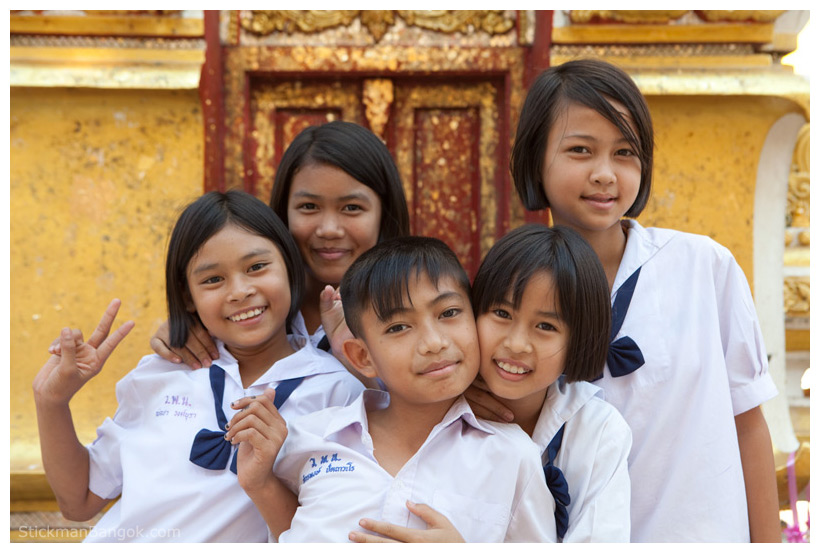
In the classroom, there is a huge difference between boys and girls and the way that they study, behave and interact.  The girls are largely well behaved, will generally respond to you if asked a question and are generally quite keen to learn, especially English.  Further, the girls tend to sit towards the front of the class.  The boys on the other hand are the complete opposite!  Boys tend to chat away to themselves, may not respond when asked a question and quite often are not that interested in studying, especially English.  How this relates to other subjects in Thai schools, I really do not know.

Along with the worst private language schools, some of the Thai high schools have some really awful foreign teachers.  Frankly, the poor Thai staff simply don't seem to know if someone is a good teacher or otherwise...and there are obviously a lot of Westerners teaching in Thai high schools that must have lied on their CV to get in the door.  The work at Thai high schools is relatively stress free, but (in my opinion) not particularly rewarding either.  You battle bureaucracy and ancient methods but this is offset by some of the marvellous kids who you will warm to and hopefully will do your very best for.  From a personal point of view, I get so frustrated at not being able to give the kids the quality of tuition that they deserve, due to the number of students in the classroom at once - and I really wonder if there is a lot of benefit in teaching kids at this level...

The Thai high schools that do go to the trouble and expense of taking on foreign teachers tend to be the better schools and with this in mind, there is actually be a bit of prestige associated with being employed at such a school.  The less prestigious schools do not always have the budget to employ foreign teachers.  What makes me laugh though is that the teachers at these schools are not the cream of the crop as many of the Thais seem to believe, and this is of course due to the low salaries paid in Thailand, and the fact that a good number of the foreign teachers in Thailand are here for lifestyle reasons.  Teaching is very much second on their list.  Harsh, but true.

The best types of high schools are the Triam Udom and the demonstration schools (know as "Satit" in Thai) which are attached to universities.  Triam Udom schools are the best government high schools and are presided over by the Ministry of Education.  There are about 15 demonstration schools nationwide and they are connected to universities and called Demonstration schools in English.  While they follow the national curriculum, they have a little bit more flexibility.  There is prestige associated with working at one of these two types of schools, especially from Thais - most foreigners wouldn't have a clue about the different types of schools.
 

Students get entry to the Triam Udom schools by way of scoring well in an entrance exam.  The same applies at the demonstration schools but if a prospective student comes from a wealthy or influential family, that could also help with entry into a demonstration school.  Students in the demonstration schools are graded in the first three years (from Mattayom 1 - 3) but in the final three years (from Mattayom 4 -6), the students are not graded and you'll find some of the better students in the demonstration schools will then try and transfer to a Triam Udom school, where there is a feeling that at Mattayom levels 4 - 6, the standard of tuition is higher.

One of the big pluses about working with kids at high school age (or younger) is that they are young enough that as a teacher, you feel as though you can still make a difference and that a year of really well prepared and delivered lessons could really help the kids and push their English ability to a new level.  Too often at language schools when the students are in their 20s, one feels that we need to cover the basics again because they never really got them the first time around.

If there is only one thing I'll remember about my time at a somewhat prestigious Thai high school, it is standing up in front of assembly with the entire school in attendance on the first day of term, being introduced and then having thousands of students, sitting in perfectly formed lines, bending down and waiing (a prayer like gesture where the palms of the hands are held together in front of the body) me.  Surreal doesn't even come close to describing it.

For anyone coming from a background working in any professional role or in a company that operated in a professional manner, the level of professionalism (read lack of) in a Thai high school may be more than a minor shock to the system.  It seems that these schools are in a constant state of chaos, with continual power plays being made by the middle aged Thai women that make up 90% of the staff.  Information is power and the Thai managers know this, only ever telling you, the foreigner (the outsider), what you need to know, and nothing else.  No value is placed on letting anyone know what is going on if it is deemed that that information is not essential to that person.  It often seems and in fact probably is the case that the Thai teachers do not have the students' best interests in mind, but try and work the system for their OWN advantage.  This makes you feel like you are totally out of the loop, unwanted and contributes towards having a very de-motivating effect and lowering morale.

It's important to differentiate between the positions in Thai high schools where you are employed by a language school which has a contract to provide teachers and with a Thai high school that employs you directly.  If you are employed by the school and have a contract with them, you will be school staff and will be expected to be there from early in the morning, around 7:40 AM or thereabouts through to the end of the day, around 4:00 PM.  You may also be expected to get involved with activities outside of regular school time such as parent / teacher events, sports days, exhibitions and any inter school sports days or events.  You'll probably be seen more as part of the school than you would if you were a contractor, although the fact that you are earning more than almost all of the Thai staff will still be the source of some resentment, and ultimately some division.  If you are employed directly by the school itself and not through a language school, you will get around 12 weeks PAID holiday a year which is the mid-term break which is generally all of October and then you will get the Summer break, meaning from somewhere around the middle of March until the middle of May.  Every school has a different policy but generally, once you have marked all of your exams and handed in the marks, you are free.  Some schools will have a summer camp program around April or May and you may be expected to get involved with this.  These can be a bit hit and miss and are usually in resorts well away from Bangkok.  Fun enough during the day but if you are unlucky, there may be nothing to do at night!  For people employed directly through the school, the workload should be fairly light, say around 16 or so periods which could mean as little as 12 contact hours per week - assuming a 45 minute period.

Given all of these holidays, along with exam weeks, you will never teach more than about 36 weeks a year and adding on top of this all of the public holidays, sports days, special days etc, you figure that a high school teacher has a fairly light load.

If you are employed by a language school but teach offsite from the language school in one of the Thai high schools, you may only be required to be there to teach your classes and may not have to be there at any other time - and you will usually not have to be involved with all of the nonsense ceremonies and other crap that goes on.  This is a situation that most teachers prefer BUT it means that you will not get the benefits of the long holidays and people employed through language schools tend to work a much higher number of hours (say 20 - 25 hours in the classroom).

There is no clear reason for it but some high schools that directly hire teachers themselves rather than outsourcing through a language school seem to handle the whole work permit / visa process in a less than exemplary manner.  Teachers may find constant trips down to the Immigration Department for visa extensions frustrating and even be asked to contribute towards small "gifts" for the immigration officers such as cakes and pizzas that are used to grease their palms and expedite the process.  Notwithstanding this, don't be surprised if your work permit and visa are not sorted out until a few months into your contract and you suffer a few headaches along the way!

At the end of the day, most Thai high schools operate in much the same way and even the purportedly best or most prestigious schools are run with a level of bureaucracy that would more than excite a die hard communist.  Even when something is absolutely obviously dumb / will not work / is unworkable, it is virtually impossible to tell the Thai manager this.  They are obstinately stuck in their ways.

But as mentioned earlier, the workload is light, the pay reasonable and the actual stress from classroom teaching is low...  I have always felt that the high school jobs are best for the former blue collar workers who find themselves in a classroom in Thailand.  Please do not dismiss this as cynicism:  Anyone who works at a Thai high school with 50+ kids in a class and believes that their methods of teaching are effective is fooling themselves.

Pros:  Monday - Friday work week, relatively low stress in terms of teaching requirements and what is expected of you.  A lot of holidays and a lot of exams means numbers of hours spent teaching, if averaged out, is fairly low - even on a week by week basis, it is MUCH lower than in a language school.  There is a real opportunity to make a difference and really help the students while they are still young and relatively open minded.

Cons:  Early start, crazy numbers in the class (sometimes up to 60), inadequate communication in the school, possibility of two sets of "bosses".  Facilities not always of the highest quality and resources are often old - or simply not available.  There can be an obligation to perform duties unrelated to teaching.  Teachers who are genuinely professional may find their ability to operate effectively stifled by constant bureaucracy and incompetence in addition to numbers that are totally unsuitable for language learning.

The Bottom Line:  This type of work appeals to a certain type of person.  I'll stick my neck out and say that many of the people working in such schools WOULD NOT MAKE IT IN A PRIVATE LANGUAGE SCHOOL!  Due to the numbers in class, this is not real teaching, I'm afraid, more akin to edutainment.  It is however an easy gig, and teachers at name schools will get automatic respect from a lot of Thais.
 

Universities

University jobs vary depending upon the type of classes that you have which tends to be based on the faculty that you are in.  You may end up teaching a small number of students in a classroom in a similar manner as you would to at a private language school using the very same course books that they do in a private language school.  If this is the case, it would help if you were an RSA or equivalent qualified teacher as the books are put together with that style of teaching in mind.  However, in a lot of university positions, it seems to me that in some faculties, there is a lot of emphasis on lecturing about how the language works and really, this is not teaching but rather, as I said, lecturing.

Chulalongkorn University, considered the best university in Thailand.

Salaries at universities for foreign teachers are set at government level and have not changed, that is, increased, for many years.  The current salary per month is 17,850 baht plus 8,000 baht a month accommodation allowance meaning that at less than 26,000 baht per month, the salary is low for a job that carries a fair deal of prestige, especially if you are at one of the better places like Chula or Thammasat.  One of the reasons that universities are able to get away with paying such low salaries is that the prestige, along with the opportunity to do extra teaching work, both within the institution, and outside, is huge.

In university positions there are generally not a lot of contract hours to do, the maximum is usually between 10 and 12 contact hours with students a week, meaning that you have a lot of free time on your hands even if you have a lot of preparation and marking / grading to do.  However, overtime is offered and can be very favourable with rates varying from uni to uni but can be up to 1,500 baht per hour.  Therefore, with a few extra hours, a teacher could easily pull in 40,000 baht a month without having done nearly as many hours as those in say a private language school or a high school position.

Contracts used to be two year contracts which were renewable annually after satisfactory completion of the first two years - but I am not sure if this is still the case.

To get a job in a Thai university, you MUST have a degree.  The better institutions, that would be the likes of Chulalongkorn and Thammasat, will in all likelihood require that you have a Master's degree and some, even a doctorate!  Preference will be given to those with a degree in English or a related field.  Little value is placed on a CELTA or a specific teaching qualification in Thai universities.  Unlike language schools which hire year round, universities tend to hire just before the academic year starts, which is late May / early June, so it is a timing thing as much as anything as to whether you get a job in such an institution.

While I wouldn't know if they discriminate by age when selecting their teachers, the average age of a teacher in a university seems to be a lot higher than the average age of a teacher in a language school.  I can confirm that most university lecturers are shown the door at 60, though as with many things in Thailand, there are always exceptions!

A good number of the universities in Thailand - and all of the best ones with perhaps the exception of Chiang Mai University - are in Bangkok itself.  There are some large regional centres in Thailand where you will not find a university at all.

Pros:  Low number of contact hours, low stress, prestige of a job in a university.  Unlike high schools where teachers often have to hang around when they have no classes to teach, many universities allow their staff to only be present when they are required.

Cons:  Relatively low income, requirement of a degree over any actual teaching qualifications or experience.

The Bottom Line:  As you would expect, a bit of a haven for academics, and academic wannabes.  Such positions are considered by many to be a relatively cushy number, given the low number of contact hours. 
 

What is teaching like, as opposed to other jobs?

Teaching is a lot of fun but it can also be stressful at the same time.  The majority of English language teachers in Bangkok appear to have come from a background doing something completely unrelated so teaching is something completely new to them.  Many agree that teaching can be a particularly rewarding job but it is also demanding and I personally find that when I am teaching, it is seldom far from my mind.  Teaching is not for everyone!

As a teacher, one is always thinking about how they can introduce new ideas and language points more effectively and how activities can be done in a manner that is both fun and effective, in terms of the students learning or using the target language.  Whereas in some jobs you can hide behind a desk, avoid calls, disappear in the company car, go for a liquid lunch, these options don't exist when teaching.  You are there on the spot and must perform!  If you are prone to skiving off and know in your own mind that you are not that professional in your approach to work, then teaching may not be for you.

The actual teaching component is just one part of the job.  Teaching is not just about getting up in front of the class and performing.  At the absolute minimum, good teaching requires careful planning of every lesson, the marking of homework and obviously the presentation and delivery of lessons within the classroom.  The classroom aspect of the job requires a lot of energy and can be draining with the torturous three hour classes so popular at language schools on a Saturday making the most energetic of us feel fatigued.  When I first started teaching, I found that I was very tired from teaching and this lasted for a few months!  On Saturday afternoons when I got home after 3 x three-hour classes, I would just conk out and sleep, waking up the next day!

Depending on the type of environment you work in, there may also be other responsibilities.  Within a language school one might be asked to interview prospective students for the purposes of grading them and placing them in the right level class.  In any teaching environment one will be asked to assist the Thai staff with various things and perhaps even helping them with their English.  There may well be workshops from time to time and you may even be expected to run one.  Basically, there is more to do than just plain on old teaching - but I like this - nice variety.

Teachers are highly respected in Thailand and receive respect simply because they are a teacher.  As such, teachers - and this very much includes the foreigners amongst the ranks - are expected to be on their best behaviour all the time.  In 2006 and 2007 there were some high profile cases of paedophiles and others working as teachers in Thailand and this tarnished the image of foreigners teaching in Thailand.  You are expected to live a clean and wholesome life, or if you are up to no good, to be very discrete about it!  The truth is that if a lot of the senior Thai members of staff knew what some of their foreign staff got up to they would be truly horrified.  Like I said earlier in the article, many people choose to teach in Thailand because it allows them to stay here legally.  Just being in Thailand is much more important than the teaching part.
 

How difficult is it to get a job?

It is not difficult at all!  For as long as I have been in Thailand there has always been lot of work around.  You do not need to arrange anything before you arrive Thailand.  In fact you could argue that any school hiring you sight unseen is probably the type of school that you want to avoid - though schools using an international agent MAY be ok.  Just turn up in Bangkok and start hunting.  Anyone who makes a diligent effort will get a job within a week - anyone with a bit of nous / an RSA or equivalent / teaching experience will get a job the day they start applying - though it may take a bit longer to get a decent job, or the type of job that you really want.  The busiest time of the year for applications is March - May and the quietest time is December - February.  In the past the latter period was little bit tricky to get a job in as it coincides with the tourism high season when financially strapped backpackers may also be searching for temporary work to finance their travels but it seems they are not as well-received in the industry these days.  There are a number of teacher training courses offered in Bangkok and whenever any of these courses finishes, there will be a number of students going around all of the language schools looking for work and the better jobs will be more difficult to secure.

There has never been a shortage of teaching work in Thailand!  Getting a job in Bangkok under 30,000 baht a month is very easy.  Getting a job in the 30 - 40K baht a month range is a bit more competitive while anything over 40K a month is ultra-competitive with such jobs sometimes attracting as many as 100 applicants!

The best place to look for work used to be the Bangkok Post newspaper, but there aren't so many jobs listed there these days, certainly no more than in the past, when the industry was much smaller.  Now, the best places to search for teaching jobs in Thailand are online.  The best place with the most job listings is undoubtedly Ajarn.com.  Dave's EFL Cafe is also worth a look and the links for these sites can be found at the end of this page.  Please note that only some of the jobs advertised in the paper edition are listed on the internet version of the Bangkok Post.  Beware of schools who keep repeating the same job offered ad over and over again.  This is a sign that they are either growing at a spectacular rate (unlikely) or they have a high staff turnover.

When applying for a job, take care to read just what information is provided in the ad.  As far as teaching in Bangkok goes, the best ads I have seen were those from Austil (which sadly closed down a few years back even though they had high numbers of students coming through the doors).  Their ads stated exactly what they wanted (RSA + degree) and they explicitly stated the very reasonable salary.  (This position from the late '90s paid much more than most positions do today!)  They then also mentioned a few other conditions and so forth.  They gave the prospective applicant all of the necessary information and did not attempt to conceal anything.  The worst ads are those that state very little, and you cannot help but wonder just what they are hiding.  Hell, Id rather read an ad that said something pathetic like "join a winning team - no experience or qualifications required" - at least you know that they are happy to take on anyone and it is a school for unqualified, inexperienced teachers.

There used to be a lot of fly by night schools advertising and their ads were usually VERY brief - English teacher required, call so and so at XXXXXXX.  While a decent school MAY place such a brief ad, in my experience most of these ads were for jobs that were truly a waste of time - more often than not they wouldn't even be a school, but rather an agency way out in the suburbs, often above a shop with a rickety old sign etc.  This is slowly changing an especially with the advent of the internet, word about bad schools spreads very quickly indeed.

For many reasons, but primarily due to many schools offering a very average salary or less than wonderful terms and conditions of employment, English teachers don't always last that long in the profession in Bangkok.  Some schools have horrendous staff turnover with the average teacher lasting just a few months.  This means that there are always positions available.  Also, the industry continues to grow and grow and grow and there are heaps of jobs available year round.

Many people start off in Bangkok as a teacher as it is the easiest type of job to get but they are forever looking for another line of work or waiting for a new opportunity to come along.  This is changing a little and standards are improving a lot, both the working conditions and the salaries offered - which is good because really, they had to.  You would not believe how bad the salaries and conditions were just 10 years ago.

With the internet the big way to hunt for jobs these days, in all likelihood your application will be made by email.  So you need to have a good letter of application and a copy of your CV - most employers seem to prefer receiving it in Microsoft Word format than in the body of your email.  Thai firms like to know what you look like when they are scheduling interviews and the way you look WILL play a part in whether they decide to invite you for an interview or not.  The photo should be a head shot, just like a passport shot, and you MUST be wearing the type of clothes that you would expect to wear on the job, e.g. a tie for men.  If you are particularly hard on the eye, look scary (this is a big thing for Thais) or are knocking on death's doorstep, it might be best to omit the photo.  You should be clean shaven and your hair should be tidy, for men that means short.  So, you would need a scanned copy of this photo, but it would help to provide the school with a photo when you first apply too.  So yeah, that means both a physical photo AND a scanned copy of the photo for all applications sent by email.

You should also obviously have copies of your education qualifications and your teaching credentials, both the originals to show the prospective employer as well as photocopies for them to keep.  It is much better to turn up with a pile of photocopies for them than to get them to photocopy your originals.

If you are applying by post, sending copies of references from previous employers wouldn't hurt either.  Do NOT send your originals as you almost certainly will not get them back!

You can of course pursue employment in Bangkok from abroad and the internet is the tool.  *IF* you get recruited while still in your home country, some employers will actually pay for your ticket out here and some may even pay for the return ticket home upon contract completion, but to be honest, such employers are few and far between.  Funnily enough, these same schools may not offer the same benefits if you approach them while here in Bangkok.

You should note however that Thai companies, organisations and schools are notorious for failing to reply to emails.  The funny thing is that these schools are often desperate for staff but for whatever reason, often fail to reply - makes you wonder doesn't it!  The problem is that often the person who checks the email doesn't understand English well enough to know what to do with it so just hits the delete button which is much easier!

There are some agents internationally whose business is placing teachers at language schools internationally.  Some of the recruitment agents charge more than $US 1,000 (about 40,000 baht) per placement and guess what happens to that cost of recruitment - it often comes out of the employee's salary!  There are some Bangkok language schools that use these firms so if at all possible, try and avoid them as you could indirectly be paying for their service!


What's it like teaching Thai students (as opposed to other nationalities) and teaching in Thailand?

Thais are a fun loving bunch and Thai students enjoy lessons that are fun.  The flip side of this is that they can become bored quickly.  In Thai culture, the idea of sanuk (translated = fun) is very important and if something is not perceived to be fun, then the students will often be reluctant to do it.  You have to keep things moving and most importantly, FUN!  It has been said that to be a good teacher in Thailand, you need to be 1/3 teacher, 1/3 entertainer and 1/3 businessman.  If you are a stereotypical chalk'n'talk teacher who stands at the board and just talks away, the students will tire of you quickly - very quickly.  This will probably result in the number of students in your class dropping - which is a classic indicator that something is wrong.  You should try and include a lot of activities and language learning / practicing games and keep the lesson moving.  As Thais can be a particularly sensitive bunch, you need to have more than a passing awareness of Thai culture too.  This can make things a tad more difficult than if you were teaching say a bunch of Westerners.  There are certain topics which you shouldn't bring up, and certain things that they find dull.  As you gain experience, you will have a better idea of what works and what doesn't.

The whole idea of teaching English as a native speaker is ultimately to set up interactive activities that allow the students to practice some specific language.  As an example you may give half the class some dummy money and a shopping list and the other half of the class a few objects that just happen to be on the shopping lists.  Half the class are shoppers and half are vendors.  They then have to use the target language that you had pre taught them to buy the different goods.  Once you have done this activity once, you may swap the roles.  The problem with Thai students is that they are inherently shy and often reluctant to use the target language or even speak English!  In a situation like this, don't be surprised to see them complete the task as you had set it up, but using Thai!  While an activity may be a dream with one class, it may be a big flop with another.  It is a little frustrating that at times, some classes are not prepared to "give the teacher a little" and actually partake in the activities.  Sometimes they will just mill around grinning at each other and saying little.  It is usually a problem of confidence and most Thai students are scared of making a mistake, saying something wrong and thus they are scared of losing face.  This can be a little tricky to overcome but is usually overcome with a little gentle persuasion.  I believe it is not such a problem with students within certain other cultures, especially outside Asia where the face thing is not so big.

The problem mentioned in the previous paragraph is more prevalent, in my experience, at language schools with students who are young adults.  People in this age group, often university students or recent graduates make up the bulk of students at language schools.  At weekends, language schools will get a lot of children.  You may also have a few middle aged folk studying as amongst the upper echelons of Thai society, there is a certain status associated with being able to speak English well.  If you want to massage (and / or manipulate!) a wealthy Thai's ego, compliment them on their English ability!

Thai students often have totally unrealistic expectations about the courses offered and some truly believe that after a 30 hour course, they are going to be fluent and be able to understand and communicate about just about anything!  To make matters even worse, Thai students attending an English class often remind me of someone going to see a movie in a cinema.  They take their seat and sit there, often doing nothing.  You get the impression that they just want to sit there and it will all magically happen.  This is probably due to the way that they have been taught at school with the rote learning method where they listen, read, write and recite.  Frustratingly, many students don't realise that if they wish to make progress, they must actually make an effort!  And when they do not make the level of progress that they had hoped for, they may go and enroll at another school, study one course there and then again, find ANOTHER new school...

While education is valued in Thailand, and proficiency in English is acknowledged as being important in getting a good job / going into business, Thai students often turn up late for class and sometimes, do not even bother turning up at all!  In some cases this can be a symptom that the student is, rightly or wrongly, not happy with the teacher but in other circumstances, it may simply be that the student is lazy or maybe even that the student was enrolled in a course by his / her parents that he / she did not want to do in the first place!

Teachers are highly respected in Thai society and Thai students are loathe to openly criticize a teacher - so even if you are doing a poor job, you may not be criticised like you would expect to be in a job at home.  This all gets taken way too far and even the 19 year old, fresh off the boat native English speaking teacher gets crazy levels of respect, despite the fact that after each day at the school he may return to his apartment to indulge in goodness only know what.  He might not even give a toss about his students or the lessons.  However, this doesn't necessarily mean that the students will study diligently.  While they may respect you, they may still gossip in class, use Thai instead of English and fail to do homework.  It's other people in Thai society that will be more impressed, particularly Thai adults who will tell you how wonderful it is that you are a teacher.

At school, students will call the teacher one of two words, ajarn or kruAjarn is rarely used correctly as the actual translation of it would be professor, someone lecturing in a university - and there aren't too many people doing that.  The fact that Thais use this word shows their respect for the teacher and although incorrectly used, it is used remarkably often.  Kru is a better word for the students to use and means teacher, though frankly, some of the English teachers working in Bangkok really don't deserve to be called a kru either.

The symptoms of an unpopular teacher are more likely to be students dropping out of the class and not signing up for more courses than, say, criticism.  These stupid surveys that some language schools hand out to students are largely a croc - or at least the ones that I have seen are.  Asking a Thai student if the teacher was any good is like asking what colour the sky is - there is only one answer!  There is no reason why surveys can't be used as an effective tool but the questions need to be formed very carefully to get useful, worthwhile responses.

On the whole, the average Thai does not speak English particularly well, especially when compared with some other South-East Asian countries like Malaysia or Singapore.  There are many reasons for this including a) L1 interference, b) a questionable education system and, c) many very poor English teachers in Thailand (both the Thai teachers within the education system and foreigners at language schools).  The Thai language is in no way related to English (as say German is) - Thai does not come from the same "family" of languages as English so students really are very much starting from scratch.  The Thai language is very basic in structure with little grammar including little in the way of verb tenses, verb forms etc.  Thai also has a relatively small vocabulary which results in the language having a general lack of expression.  If you compare sentences in Thai with the English equivalent, the English version is far more complex.  The Thai script is totally different from the Roman script meaning that the Thai student must learn a new alphabet.  (Many foreigners complain about written Thai being incomprehensible - well the Thais are forced to learn our script.)  The one major complexity with Thai is the tones in spoken Thai.  When spoken well, Thai can be very pleasant on the ears.  Thai students invariably have difficulties with the pronunciation of English.

At most language schools offering General English courses, most students seem to study at either Elementary or Pre-Intermediate level.  Some schools will have students studying at Intermediate level.  Whereas in European language schools there are many higher level classes, in Thailand, Upper Intermediate is rare and genuine Advanced level classes are  virtually unheard of.

Thai students are petrified of tests and exams and this goes back to the school system in Thailand.  Thai students get tested frequently and they have to pass a test to go on to the next level.  Failure to do so means that they have to re-sit the test (which can be many times) or in worst case scenarios, they may have to study the whole syllabus again.  Whenever you test your students, you will find them very nervous and scared and you need to manage this carefully.  Further, you need to ask yourself carefully *why* are you testing them.  Too many teachers just give students a test because it kills a lesson but the students may not necessarily get a lot out of it e.g. the students do the test which the teacher then marks and gives back to them with little if any feedback and review.  A good teacher would go over any areas where several students made the same errors and if necessary teach that language point again.  In general English taught at many language schools, I question the wisdom of a lot of the testing that gets done.  It can be a useful tool but too often seems to be the old "this will kill two hours" and that is bad news.

Although I do not have a background in education and am therefore admittedly not the best qualified to pass comment on it, I believe that the Thai education system is weak - at best.  Basically, students are not taught to think for themselves - an absolute crime.  A lot of this probably goes back to Thai culture and this idea of the communal society.  At school, students study English for years and when they leave school, they are lucky if they can put together more than one or two grammatically correct sentences.  Too much time is spent on reading, writing and grammar and not enough time on speaking and actually using the language.  I had one student who studied English for eleven years at school, four years at University and had had three months intensive study at a language school in Singapore and another three months at a language school in England.  She came to the school I am working at as a student studying at Elementary level.  On top of all of this, I have taught in two prestigious high schools and can quite safely say that in terms of quality of education, these schools would not be considered anything special in the West.

You could do a lot worse than try to learn Thai, if only for the purpose of seeing the challenges that face the Thai student who is trying to learn English.  Bear in mind that learning a language is a very difficult long term challenge and you need to be patient with your students.  Fortunately, most Thais are particularly amiable and are not that demanding of results.  However, as a responsible teacher, you should still strive for them to get the maximum benefit out of the course.

One of the big drawbacks of teaching in Thailand is that there are not a great deal of quality, experienced teachers meaning that there may not be a great amount of development in your role.  Although building up time in the classroom is important, it is equally important to have experienced teachers to bounce ideas off, to run lesson plans by and to generally help you out while you are still inexperienced.  Many DOS's and head teachers at schools in Thailand would only be considered mediocre teachers in other countries with a more developed industry.  This can all result in teachers working a year or two and thinking that they know it all and are fully competent but are actually not nearly as good as they think they are.  In fact, there are some teachers who have been here for a few years who are bloody awful.  I have yet to meet an unqualified teacher with a couple of years experience who didn't rate their ability in the classroom very highly.  Beware that in the west, the person we report to, our manager, supervisor, trainer, whatever usually has a lot more experience than us and is usually in that position for the very reason that they are better at that than we are.  We listen to them when they provide feedback on our work and will often take on any suggestions that they may make.  Some of the DOSs in Thailand are shockers and some of what they come up with is terrible.  Be VERY judicious when dealing with these people and just because they are your superior doesn't always mean that they are right.

The other side of all of this is that while there are not a great deal of quality teachers, there are also relatively low expectations.  Those with white skin with a tidy appearance, who are punctual and smile a lot will be considered good teachers at some schools irrespective of what happens in the classroom.  There is not a great amount of stress from your boss in a Thai language school - you will probably get more stress and anxiety from students who are keen to learn.

Bangkok attracts all sorts and you will meet some characters, some weirdoes, some creeps, - seldom will you meet anyone whom you could truly classify as boring.

Do I want to do a training course before I actually start teaching?  What teacher training courses are available in Thailand?

Many of the teachers teaching in Bangkok both have no formal teaching experience (before coming here) nor a teaching qualification.  I chat with many people who want to teach here and they often start the conversation like this, "I can speak English very well so I don't think I'll have any problems being a teacher".  Sorry my friend, that simply is not how it works!  I know a couple of teachers who don't even speak the language that well themselves but they are damned good teachers.  Why?  Because they know how to teach!  The trick is being able to build a rapport with students, having a good knowledge of how the language works, explaining this to students and most importantly doing interactive activities that allow the students to practice the language.  Being able to speak English well is only a small part of it, a very small part.

If you are going to be teaching for any length of time, I strongly recommend that you do an English teachers training course before coming to Bangkok.  The most recognised course internationally is the Cambridge University CELTA course that is offered at about 100 or so language schools world-wide.  The cost of the course varies from country to country with some example prices from the late '90s were:  United States $US 2700 (VERY expensive!), New Zealand $NZ 2750, Australia $A 2500, England UK pounds 1100+, Thailand $US 1400, Egypt $US 1040 (cheapest place in the world to do the course).  The Trinity College course is very, very similar and is also offered by language schools world-wide.  These one month full time courses are in my opinion, the best single way to prepare yourself to be a teacher BUT these courses alone will not make you a good teacher.  It takes a lot of teaching practice and experience before you get to the level where you can genuinely claim to be a good teacher.  In an ideal world, one would have a degree in education, an MA in linguistics and an RSA.  In reality, and especially so in Thailand, this just doesn't happen!

It should be noted that there are many different teacher's training courses available and different schools and different people will put a different value on each of them.  Generally speaking the English / Aussies / Kiwis / South Africans prefer the English courses and the Americans / Canadians prefer the American courses.  The English courses involve a lot of hands on practice teaching and prepare you for ACTUALLY TEACHING with lots of real teaching practice.  The American courses tend to be more theory and academic based and seem to be more a study in how the language works and general linguistics than anything else.  I personally put little value on the American courses from the point of view that they do little to actually make you a good teacher.  There is also an emerging market of "internet based teacher's training courses".  Sorry folks but I am extremely cynical of such things - but then some training is better than no training.

There is no harm in teaching for a few months before you do the CELTA.  It would definitely make the RSA a lot easier!  Most trainees find it a gruelling course and believe that they would have done better if they had attacked it after a few months teaching experience.  Although it is recognised world-wide as THE course, it is a little stiff.

* About the CELTA

The RSA is a four week intensive course that prepares you for the job of English teacher.  It should be stated that although about 90% of the people that complete the course pass it, it is by no means easy.  There is a pre-course selection test and interview that aims to filter out those who may struggle.  The pre-test includes various grammar based questions that require the use of a grammar book or the assistance of a friend who is either a teacher or has a very good knowledge of grammar.  The interviewer who interviewed me was very clever and other than asking about my general background etc., he also asked a lot of probing questions about my ideas regarding staff training, teaching methodology etc.  I believe he was trying to see if I had many pre-conceived ideas about such things.  (I'd done my homework at that stage, reading a couple of books and gleaming numerous amounts of info from the 'net so he couldn't quite out smart me....hehehe!)

If you have never taught before, you will need as much time as possible to dedicate to the course to ensure that you pass it.  Many of the concepts can be quite foreign!  The course includes six hours practical teaching to REAL students, teaching techniques, preparing lesson plans, scheduling, grammar lessons, observation of CELTA qualified teachers teaching real classes and a hell of a lot more.  There are six written assignments to complete on the course and this, along with your "TP" (teaching practice), form the basis of your assessment.

The course moves at a very brisk pace and if one was to fall behind, it would be very difficult to catch up.  The course outlines state that you must be free of any other distractions like part-time work or other study and need to dedicate all of your time to the course.  In reality this is not the case.  I was busy with a stack of distractions when I did the course and about half of the people on my course were working part-time.  However, do expect to be up late at night preparing lessons for the following day.  You can't just bluff your way through this course.  You will get stressed!  If you are not on course to pass the course, the instructors will have a quiet word with you and advise you that you need to pull your socks up!

One does need to take the course seriously and prepare as much as possible before hand - it would be a good idea to buy a good grammar book and study as much about English grammar as you can - this was the area where I was weak and had I made a more diligent effort to familiarize myself with the material before the course, I may have found it easier.  Certainly when I was at school, we never studied grammar at all so when I was asked to teach something that I didn't understand entirely myself, the pressure really came on!

There are four grades - pass, pass b, pass a and fail.  About 80% of people receive a standard pass.  Pass "A" and Pass "B" require real dedication and tend to be awarded to those who have had previous teaching experience.  Before you receive your final certificate - which in my case came about six weeks later, you get a "written report" from the school which should be kept with your CELTA.  If you successfully complete the RSA and want to study further, after you have a couple of years post RSA experience under your belt, you can enroll for the CELTA Diploma.  I've never done this (nor will I ever do it!) but gather that it is supposed to be really good.  However, it is not scheduled that often and is also very expensive.

The Trinity College of London course is considered to be the only equivalent to the RSA.  It is no longer offered in Thailand.  It used to be offered by TEFL International but they chose to offer their own course instead when Trinity increased their affiliation fees by 75% in 1999.

The CELTA is offered in Thailand by ECC at their main branch in Siam Square, central Bangkok and, from March 2005, at their second teacher training centre in Phuket.  The current cost is $US 1,400 (about 54,000 - 58,000 baht).  If you were to do the CELTA at ECC, be sure to have accommodation very close to Siam Square.  You have enough to worry about on the course without having to worry about without battling Bangkok's notorious transport getting to and from your accommodation.  ECC offers a list of various accommodation in the area that is available at reasonable prices.  They have been running the CELTA down in Phuket since March 2005.

In Thailand, a very good alternative to the RSA is run by TEFL International who run a four week intensive TEFL certificate course on the beach near Ban Pe - less than three hours by road southeast of Bangkok.  The picture of the boats here was taken just across the bay on Ko Samet.  Imagine being able to escape the rigours of a course to a beautiful island just a 30 minute boat ride away - that is just one of many reasons why TEFL Internationals teacher training course is the most popular in Thailand.

TEFL International prides itself in offering an affordable, humane course of the highest quality with excellent job placement assistance.  The course fee is about 60,000 baht and that includes a private, air-conditioned room as well as all course materials.  They don't subscribe to the "boot camp" mentality of many RSA and Trinity courses.  In fact they are proud of the fact that no one has failed their course (although a few trainees have dropped out voluntarily over the years).  And because they are unaffiliated with a language school they can actively work with trainees to help them find jobs at any school in Thailand or abroad.  It is not uncommon for them to sit down with trainees and make phone calls for them to arrange job interviews and even secure jobs!

They were, until 31 December 1999, one of the largest and best Trinity certificate course providers in the world.  While they are now affiliated with the Association of TESOL Qualifying Organizations, the course content and main personnel are the same as their days with Trinity.

TEFL International also seems to have a very enthusiastic and supportive group of alumni - they seem to be always posting comments (almost always positive) on sites like Dave's ESL Cafe.  This is probably the way to go if you are planning on doing a training course here in Thailand.  I rate this course as being better than the RSA offered in Bangkok and if asked for recommendations as to the best teacher's training course in Thailand, this is the one that I believe in - I wish I could have studied there!

Certificate courses offered through TEFL International are now eligible for university credit at many universities.  Several US universities are now offering their students credit for taking this course.  In fact many university students will now be able to take a TEFL International TESOL certificate course and complete a four week internship and receive 12 university credits.  By reaching the twelve credit plateau, these students will be considered full-time students and eligible for financial aide!  They will be able to pay for their term abroad using student loans and grants.

TEFL International offers courses in Thailand as well as many other countries, about 15 at the last count.  For more information visit their web site at: Teflintl.com

The British Council used to advertise teacher training courses from time to time.  I'm not sure exactly what courses are offered but I imagine that the quality of the courses would no doubt be pretty good.  I seem to remember them offering a "pre-RSA preparation" course a while ago.

Text'n'Talk, now a major player in the locally based teacher training market, offers a teacher training course.  They make many bold claims in their literature about their course including the following points - better than the RSA, it's more suitable for Thai students than the RSA, it's recognised worldwide etc.  Some of these claims are moot points.  There are two courses offered, one is 120 hours and costs around 40,000 baht (if you are farang - cheaper if you are Thai) and runs 5 hours a day, 4 days a week for 6 weeks plus a minimum of 6 hours observed teaching practice, so 126 hours overall.  They also offer the same course with less teaching practice on Sundays 10:00 - 16:30 for 18 weeks for 25,000 baht.

Perhaps worst of all - and certainly a pet hate of mine, is that this school employs a dual pricing system in that Thais can get a special discount.  I avoid and recommend to all others that any business (of any nature) that offers such a discount, read DUAL PRICING, be avoided.  (Or when you apply, say you are Thai and see what discount you get - then tell them you are farang and that you want that discount!)  Sure, Thai teachers do earn a lot less than farangs do, and using this as an argument has some validity, but overall, if they can offer the course at one price to one nationality, why not the same to all?  And if you are going to take this argument through to is natural conclusion, should Americans not pay twice the price as say Kiwis and Aussies whose respective currencies are much weaker?

The TEFL1 course started in early 2001 and is held every second month.  The course is held on four days being four Saturdays and is described as an intensive course.  I am sceptical about these short courses but I will reserve judgement as I have not had a really good look at what they are offering but it does appear from their brochure that they are cramming a lot into four days.  The cost for the four day course was $US 450 when it started but what it costs now, I just do not know.  Despite reservations about them cramming a lot in, sometimes the full month courses offer more than some people really want (i.e.  some people just want to teach for a year) and they are also very expensive.  This course provides a good value alternative.

Via Lingua offers one month courses for around $US 1,500 in Phuket.  Not much is known about them other than that they got going in Thailand around mid 2001.  It should be noted that the course is offered in Phuket Town which is on the opposite side of the island to all of the popular beaches.

Not to be confused with TEFL International, TEFL Teacher Training International started in October 2001, a breakaway school started by two of Text'n'Talk's former teacher trainers.  Little is known about them.

How long am I going to do this for?

The answer to this question also affects the question above.  If you just want to piss about and have a bit of fun in Thailand then it probably doesn't matter where you teach or whether you are qualified or not.  At a guess, teachers here for a short period of time probably make up 50%+ of the teachers in Bangkok.  (But please, try and make an effort for your students - some of them are so keen to learn and many really look forward to it.  Further, financially, it is often not cheap for them at all.)

You can also muck companies around and skive off when you want - some companies are so desperate for staff that they won't actually dismiss you until you have proven to be absolutely, totally unreliable.  Sadly there is little loyalty shown by companies to their staff and vice versa in this industry in Thailand.  If you want to stay here for more than a year, then it pays to be selective about who you choose to work for.

Remember, the longer you are away from your home country or chosen industry, the harder it will be to get back into regular employment in your home country.  Living and working in Bangkok is a wonderful experience but if you do it for more than a couple of years it might not contribute towards your future employability.  Many people only plan on one - two years in Thailand but they find that they really enjoy the Thai lifestyle and never leave!

One of the sad things about teaching is that you can do it for a long, long time without really doing a lot for your future prospects, be it improving your skills, gaining experience or even saving money.  In most professions, the more time you spend doing that type of work, the better your chances are of getting a better job, usually directly related to what you are doing or within either that particular company or industry.  If the job itself is a bit of a dead end job, you will usually be able to work your way up through the company's ranks - even if you start in the mailroom.

Teaching in Thailand isn't like this and the industry in Bangkok is a classic example of an industry where experience is not rewarded financially - or only a little.  The salary band for teachers at many schools is often pretty narrow and as an example at one school I know, the total salary band for foreign teachers, irrespective of how long they have been there, is 33,000 - 36,000.  As a completely inexperienced teacher, you may start on 33,000.  A teacher with 15 years experience may get 36,000, the top of the band, only 3,000 baht per month more.  At state run universities, the salary is a bit over 25,000 baht per month, irrespective of experience!  OK, so this is an extreme example but it does represent the point well.  Experience doesn't necessarily correlate to a big increase in remuneration.  Compare this with managerial jobs in the west where say an entry level supervisor may get as little as $25,000 PA but up to 10 times that figure or more may be offered for senior management - experience IS rewarded there.

Teachers can go on to be head teachers, DOSs, managers or maybe even to own and run their own school but at the end of the day, if you want to stay teaching as such, there isn't really a lot of incentive financially to continue to do it.  There really is nothing in the way of a career path.  If you're young, you really do need to keep this in mind.  For older guys, those guys who have perhaps decided that they wish to see out their work life in Thailand, then it is not such a big deal.  So, if you are financially driven, you may want to consider this.  Obviously, there is always Korea, Taiwan or Japan if you want to pursue the big bucks in teaching BUT you don't need experience to go there either...!
 

How much money does teaching pay in Bangkok?  Am I able to save money while I'm teaching?  How much money do I need to survive?  (All figures here refer to Bangkok - outside of Bangkok you can expect to both earn and get by on less.)

While English teaching is the easiest work to get as a foreigner in Bangkok, it is also the lowest paying type of work farangs do.  As a rule, anything less than 25,000 baht will only be enough to survive on - and many people would really struggle to survive on this, and a good number simply feel that such a figure allows a standard of living that just ain't fun!  Certainly, forget any luxuries and you'll have to go native in many aspects.

About 30,000 baht should be enough to live on but without any luxuries or much in the way of Western treats.  (Remember, the more Western comforts you desire, the more money you need to spend!)  If you want to have some fun or have a few Western comforts, you'll probably need to be earning at least 35,000.  If you are earning over 40,000 you should actually be able to have an ok lifestyle.  Earn over 50K a month and you should be able to have a few weekends away, buy some reasonable clothes and a few other bits and pieces, perhaps even save a bit.  Obviously it all depends on your personal spending habits.  I personally would find it very difficult to live in Bangkok on less than 40,000 baht per month and would simply refuse to work for much less than this, at least as a full time employee.  To me, I would rather be back in the West because 40,000 baht just isn't a lot of money in Bangkok any more.  When I first came here in the late '90s, 40K a month was considered a very good salary but costs have gone up a lot since then.  Just a coffee at Starbucks can run over 100 baht, and there is so much more to see, and do.  Frankly, one reason one could happily exist on 25K baht a month in the past was because there was so much less to do in Bangkok, than compared with now.  Hell, even bus fares have DOUBLED over the last seven years!

I feel that these figures and estimations on salary would be relevant to most career English teachers, and people with a similar mindset to the average teacher.  There are plenty of people who find that the salaries offered in Bangkok are simply not sufficient for them to live on - and they often end up in Taiwan, Korea or Japan - or even go back home to their own corner of Farangland.

The cost of your apartment will probably be your biggest expense so if you can save money on this, you will have more money for other things.  (Drinkers take note:  If you drink a lot, this could easily cost you more than your apartment rental.)  There are unlimited entertainment options in Bangkok and few people spend many nights in their apartment.  (Incidentally, there are some expats in Bangkok earning 500,000+ per month and still managing to spend a good chunk of it!  The point here being that just about any other job employing foreigners pays more than teaching....)  For what it's worth, I spend around 45,000 baht per month and for this, I consider that I have a very nice lifestyle - smallish, centrally located apartment, Western comforts whenever I want them and more than enough money for eating out and entertainment.  This would NOT cover my expensive hobbies though, like photography, for which I need extra income.

Truth be told, I used to be happy on 35,000 baht a month, back when I was earning it.  I had a pleasant life, not special, but pleasant, and I didn't look too far into the future.  A few years on and I am much more concerned about the future.  That is one reason I just could not go back to a standard job again.  Sometimes you just have to make the hard decision and say that earning 30 - 35K baht a month is ok for the first two years, but beyond that, you really need to look at breaking into a higher paying gig, supplementing your teaching somehow, or getting into a whole new profession.  Teachers are not well paid in Thailand and don't let people saying "well the average Thai only gets 10,000 baht per month" lead you into a false sense of security.  30 - 35K baht jobs are a treadmill to nowhere.  You can do better, farang!  NEVER FORGET THAT!

Salaries are usually paid monthly, on the last day of the month, although some firms pay twice a month.  While most schools will pay you via